

2 February 2026, Geneva, Switzerland - In January 2026, the United Nations Institute for Training and Research (UNITAR) reached a major milestone with the issuance of its first-ever digital certificate of completion. Issued on 31 January 2026 by the One UN Climate Change Learning Partnership (UN CC:Learn), this certificate marks the culmination of a months-long process to introduce state-of-the-art certification at UNITAR, responding to the needs of an online learning environment that continues to evolve rapidly.
More than a technical upgrade, the launch represents a strategic pivot towards innovation in how UNITAR recognizes learning achievements. As skills-based recruitment grows and digital certificates (also known as digital credentials) become increasingly common, UNITAR’s new approach helps ensure that learners can demonstrate their accomplishments in ways that are trusted, portable, and easy to share.
Why This Matters
Certificates play a key role in supporting learners as they pursue new opportunities, demonstrate competence, and build different skills. However, traditional paper-based or PDF certificates are not always easy to verify and can be vulnerable to alteration or misuse.
UNITAR’s new digital certificates are blockchain-secured, which provides the highest levels of security and verifiability. Each certificate can be authenticated through a secure and simple verification process, giving employers, institutions, and other stakeholders confidence that the credential is legitimate and has not been tampered with.
For learners, this is equally important: it means that their achievements are backed by a certificate that is durable, portable, and recognized in digital-first professional and academic environments, where quick validation and transparent proof of learning matter more than ever.
Built for Today’s Learners
UNITAR digital certificates are fully aligned with learners’ expectations in the online world. They are:
- Easily shareable across professional platforms and social networks
- Simple to add to CVs and online profiles
- Downloadable for personal records
- Verifiable via a direct link, which learners can easily share with employers or institutions for instant confirmation
- Accessible anytime from anywhere
This makes it simpler for learners to translate completed training into real-world value, whether applying for a new role, supporting career development, or documenting continued education.
How UNITAR Digital Certificates Work
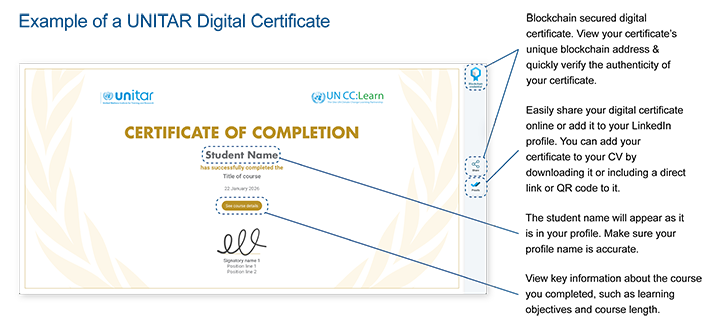
UNITAR’s digital certification process is designed to be straightforward for learners while ensuring robust credential integrity behind the scenes. Here’s the journey to getting a UNITAR digital certificate:
- Complete the course requirements: Learners must successfully complete the required activities and meet the course completion criteria (for many courses, this includes achieving a passing grade in the final, summative quizzes).
- Request the digital certificate: Once the learner qualifies, the pay-for-certificate[1] button becomes available through the course interface. Click the button to be redirected to the payment page.
- Payment: Learners are required to pay[2] a nominal fee for their certificate. The fee depends on the course, but the contents of the courses remain free. This fee supports platform sustainability and continued improvement of learning services.
- Access, download, and share: After the payment is confirmed, the certificate is issued. Learners can access it directly from the course page and share it on their social media channels. The URL of the digital certificate is also sent by email. A PDF version can also be generated and downloaded from the digital certificate page.
- Instant verification: The authenticity of the certificate can be confirmed through its verification function, which is supported by blockchain technology.
[1] Certificates issued by the One UN Climate Change Learning Partnership (UN CC:Learn).
[2] Certificates issued by the One UN Climate Change Learning Partnership (UN CC:Learn).
What Makes it Different from PDF-based Certificates?
UNITAR has historically issued paper- or PDF-based certificates, which remain familiar and easy to store. However, PDF certificates have limitations in an increasingly digital landscape, including limited shareability and limited authentication features.
By contrast, UNITAR’s blockchain-secured digital certificates are designed for trust, portability, and modern verification needs.
In short, the digital certificate is not just a document; it is a credential built for the realities of today’s online learning landscape.
Get Your Digital Certificates
Complete one of the four courses below to start benefiting from digital certification:
- Climate Change: From Learning to Action (available in English, French, Spanish, Russian and Chinese)
- Sustainable Diet (available in English, French, Portuguese and Indonesian)
- Plastic Waste and the Basel Convention (available in English, French and Spanish)
- Introduction to Sustainable Finance (available in English)