

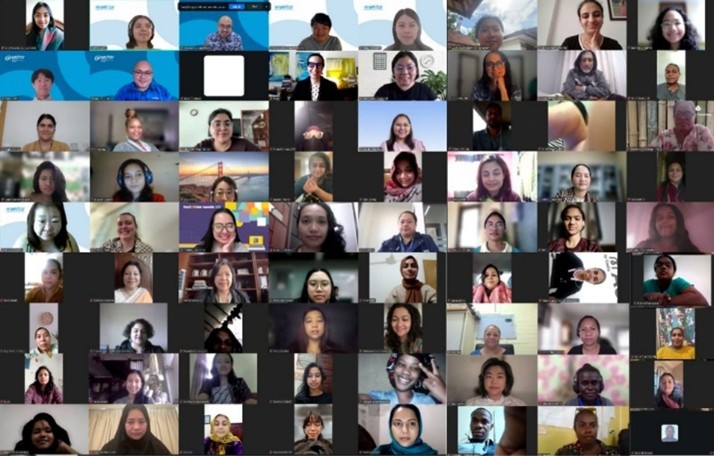
- On 19 November 2025, the UNITAR’s “Women’s Leadership in Disaster Risk Reduction for World Tsunami Awareness Day 2025” programme concluded its online first phase with over 380 learners from Asia and the Pacific.
- This first phase began on 10 September and featured asynchronous online learning, peer-to-peer interactions within the online community, and four expert webinars.
- Phase 2 of the training programme will take place from February to March 2026 for top 40 performers.
UNITAR
8 January 2026, Hiroshima, Japan – On 19 November 2025, the United Nations Institute for Training and Research (UNITAR) concluded the first training phase of its “Women’s Leadership in Disaster Risk Reduction Training Programme for World Tsunami Awareness Day 2025”. Over 380 learners from Asia and the Pacific completed the 2-month phase, which highlighted the importance of gender-inclusive leadership and introduced them to core disaster risk reduction concepts, key principles of the Sendai Framework and the Sustainable Development Goals (SDGs), ecosystem- and community-based approaches to disaster risk reduction, and lessons from Japan’s disaster experiences.
The programme, funded by the Government and People of Japan, aims to build the capacity of agents of change from Pacific Island countries and Asian countries to enhance skills in disaster risk reduction and inclusive leadership. The top 40 learners will continue on to the second phase in February 2026.
Phase 1: Introduction to Core Disaster Risk Reduction Concepts
UNITAR
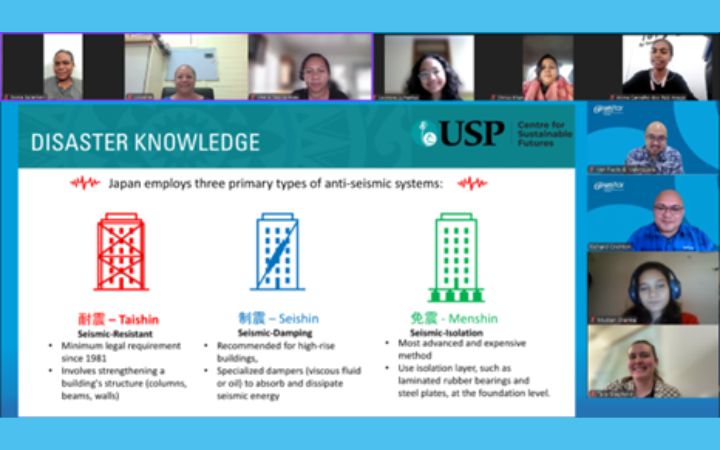
The first phase ran from 10 September to 19 November. The participants from the Asia-Pacific learned about women’s leadership and disaster risk reduction through self-paced online learning on a mobile-first microlearning platform designed for low bandwidth environments, peer-to-peer interactions within the online community, and four expert webinars.
- The first expert webinar, on 24 September, introduced participants to key disaster risk reduction concepts. The speakers, Ms. Gabrielle Emery (Head, United Nations Office for Disaster Risk Reduction Pacific Sub-Regional Office) and Dr. Anawat Suppasri (Tohoku University), drew from case studies from the Pacific Islands and Japan, engaging participants in scenario-based group exercises.
- The second webinar, held on 8 October, featured Mr. Tuileva Tuileva (Senior Project Officer, Pacific Climate Change Centre) and Dr. Richard Crichton (Lecturer, University of the South Pacific). This substantive session covered climate change and building resilient communities, inspiring interesting discussion among the participants.
- The third webinar, held on 29 October, focused on gender and inclusivity in disaster risk reduction. Participants gained valuable insights from Dr. Miwako Kitamura (Specially Appointed Associate Professor at Tohoku University) and Ms. Karishma Narayan (the Gender and Protection Advisor to the Government of Tonga’s Ministry of Internal Affairs).
- The fourth and final webinar was held on 19 November. Participants explored inclusivity and the importance of traditional knowledge with Dr. Ven Paolo Valenzuela (Research Fellow at Singapore Management University) and Dr. Richard Crichton.
Participants also learned from each other through the Prosperity Unlimited online community, where they shared information and ideas.
In wrapping up the first phase, UNITAR emphasized the importance of collaboration mechanisms across Asia and the Pacific and acknowledged the participants’ dedication and concerted endeavours throughout the phase.
Top Performers to Continue to Phase 2
The 40 top performers of Phase 1 will continue to the next phase, which will consist of an online workshop series (3-17 February 2026) for the non-Pacific cohort and an in-person workshop in Samoa for the Pacific cohort (9-12 March 2026). They will participate in extensive training, combining localized study and in-depth learning facilitated by experts from diverse backgrounds.
Participants will develop a technical understanding of disaster risk reduction and its assessment tools, deepen their understanding of the needs of vulnerable groups, learn to use nature-based solutions and indigenous knowledge. They will also strengthen their disaster communication and leadership skills for effective disaster prevention, response and recovery, with a focus on managing stress and mental health. At the end of the course, participants will present their project plans for ideas to support disaster risk reduction initiatives within their communities.
About “Women’s Leadership in Disaster Risk Reduction for World Tsunami Awareness Day” Training Programme
The programme has been implemented by UNITAR since 2016, with the support of the Government and People of Japan, to empower professionals to help their countries and communities better prepare for, confront and recover from disasters. The programme focuses on the gender-specific capacities and vulnerabilities in communities, reflecting the all-of-society inclusive approach called for in the Sendai Framework for Disaster Risk Reduction.
Learn more:
Women’s Leadership in Tsunami-based Disaster Risk Reduction Training | UNITAR
About UNITAR
The United Nations Institute for Training and Research (UNITAR) is a dedicated training arm of the United Nations. In 2024, UNITAR trained approximately 550,000 learners around the world to support their actions for a better future. UNITAR has a global presence, with offices in Geneva, Hiroshima, New York and Bonn and networks around the world. Find out more at unitar.org