

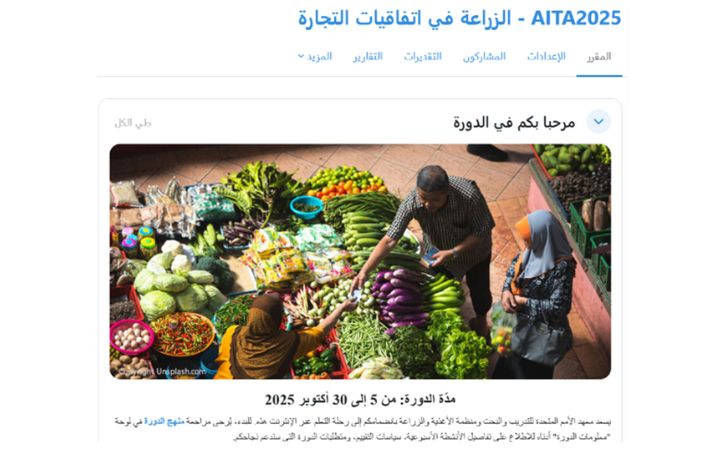
- The new UNITAR and FAO course “Agriculture in Trade Agreements” in Arabic concluded on 30 October 2025.
- The 4-week course trained 88 government officials and practitioners, including 45 women, from 20 Middle East and North Africa countries, enhancing their skills in trade policy and agricultural negotiations.
- Designed with adult learning principles, the course combined flexible self-paced learning with expert webinars, practical case studies, and mentor support.
- Participants rated the course highly, especially for understanding WTO rules and negotiating regional trade agreements, and praised its relevance to national policies.
- This marks a key milestone in the 15-year partnership between UNITAR and FAO.
© FAO
3 December 2025, Geneva, Switzerland – The United Nations Institute for Training and Research (UNITAR) and the Food and Agriculture Organization (FAO) wrapped up their newest course, “Agriculture in Trade Agreements” on 30 October 2025. Delivered in Arabic, this course is the latest development in the 15-year-long UNITAR-FAO partnership.
The 2025 course brought together 88 government officials and practitioners from across 20 countries throughout the Middle East and North Africa. Women represented 45 of the 88 participants, aligning with UNITAR and FAO’s shared commitment to promoting gender equality and women’s leadership in public institutions. The cohort included government officials from ministries of agriculture, trade, and economy, as well as practitioners from customs administrations, inspection services, universities, and farmers’ organizations.
The 4-week FAO-UNITAR course paired FAO’s technical expertise with UNITAR’s experience in adult learning and online delivery. It enabled participants to engage with complex trade rules in a way that is directly relevant to their daily responsibilities. The course covered topics such as non-tariff measures under the World Trade Organization (WTO) Agreement and trends in Regional Trade Agreements (RTAs) that affect agricultural trade and policies.
It combined self-paced learning with weekly expert-led webinars and discussion on UNITAR’s e-learning platform. Such hybrid teaching accommodates the different schedules of working professionals and is best adapted to adult learners. Accordingly, it received very positive results, with 97 percent of participants indicating approval in a post-course evaluation survey.
I greatly benefited from the content …. The course enhanced my understanding of the theoretical and practical dimensions of international trade agreements in the agricultural sector. I learned how to analyse the provisions of these agreements and their effects on agricultural markets, in addition to understanding the legal and commercial mechanisms that govern agricultural trade between countries.
– 2025 Training Participant
The participants overwhelmingly indicated that the course was highly effective. More than 88 percent reported that they fully or mostly achieved each of the course learning objectives. Participants found it particularly useful for developing their understanding of the WTO Agreement on Agriculture and navigating regional trade agreements. They appreciated the practical case studies and contextual familiarity and applicability to their countries, mentioning these consistently as major selling points of the course.
The course broadened my perspective and may allow me to become one of the agricultural negotiators [in my country] in the future, especially in discussions on proposals put forward by WTO members.
– 2025 Training Participant
Both delivery and teaching style were highly rated, at 99 percent. The participants particularly appreciated the availability of mentors, the responsiveness of the UNITAR team to all inquiries, and the flexibility of the self-paced e-learning platform. Operational support from UNITAR was also received very positively, with all participants stating their satisfaction with it.
A Learning Experience Designed for Adult Professionals
Interest in the course and the participants’ reactions confirmed that targeted Arabic-language training on agriculture and trade remains a priority for many countries in the MENA region. Indeed, when the call for applications was issued, UNITAR received 516 applications from 25 nationalities.
This course is very useful and directly aligned with my work. I will use it to provide comments and recommendations regarding the direction of agricultural trade policy in my country.
– 2025 Training Participant
The course responded to a clear need in a region where agricultural trade is closely tied to food security and rural development, both of which are central to sustainable economic development. Since the creation of the WTO, the value of global trade has almost tripled. For many small and import-dependent countries, this has created new market opportunities while also raising policy challenges around market access, export readiness, and the design of domestic support.
About the FAO-UNITAR Partnership
© FAO
The United Nations Institute for Training and Research (UNITAR) and the Food and Agriculture Organization of the United Nations (FAO) have a long-standing collaboration aimed at expanding access to education and training to strengthen the capacities of stakeholders, with training activities on a wide range of topics being implemented since 2010.
The partnership builds upon the strengths of both institutions by transforming the knowledge and expertise provided by FAO into high-quality learning products and services designed to transfer knowledge, impart skills, raise awareness, and take full advantage of modern information and communication technology (ICT) for greater outreach and cost-effectiveness.
About UNITAR
The United Nations Institute for Training and Research (UNITAR) is a dedicated training arm of the United Nations. In 2024, UNITAR trained approximately 550,000 learners around the world to support their actions for a better future. UNITAR has a global presence, with offices in Geneva, Hiroshima, New York and Bonn and networks around the world. Find out more at www.unitar.org