
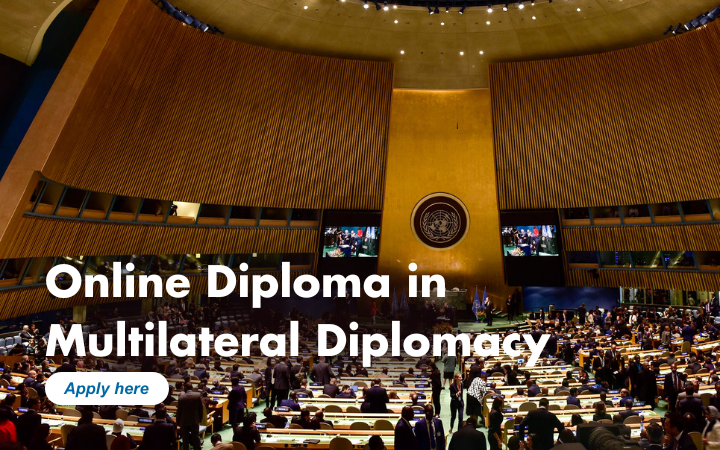
The Online Diploma in Multilateral Diplomacy offers a unique opportunity for students wanting to pursue a career in international relations, professionals working in international and regional organizations, as well as governmental and non-governmental institutions, to expand their knowledge on international affairs and strengthen their capacities in the field of multilateral diplomacy. All e-Learning courses are built on UNITAR’s wealth of experience in designing and implementing training workshops on diplomacy and multilateral affairs. We offer a 25% discount for group bookings (10+). Please don't hesitate to contact mdp-elearning@unitar.org for further information.
The Diploma is offered entirely online, and is designed for a wide range of professionals including government officials, diplomats, private sector specialists, practitioners in the international arena, academics, and other stakeholders.
STRUCTURE
To be awarded the Online Diploma, participants are required to successfully complete four e-Learning courses and submit a valid final research paper before the final deadline.
The programme fee of USD 2,600 includes enrolment in four e-Learning courses, as well as the submission of the final research paper component. Additional course enrolments are subject to a separate fee.
The eligible e-Learning courses the students can choose from are:
- Public and Cultural Diplomacy in a Multipolar World (7 September – 18 October 2026)
- Climate Change Diplomacy: Advanced Negotiation Skills and Strategies (14 September – 11 October 2026)
- The Art of Speechwriting - Fall Edition (12 October – 1 November 2026)
- United Nations Protocol - Fall Edition (12 October – 8 November 2026)
- Cross-Cultural Communication: Developing Cultural Awareness, Competences and Skills (2 November – 29 November 2026)
- VUCA Diplomacy (16 November – 13 December 2026)
- Art of Speechwriting - Spring Edition 2027 (8 February – 28 February 2027)
- Public and Cultural Diplomacy in a Multipolar World (1 March – 11 April 2027)
- United Nations Protocol - Spring Edition 2027 (10 May – 6 June 2027)
- Overcoming Negotiation Deadlocks - 2027 (10 May – 6 June 2027)
- Diplomacy 4.0 - Beyond the Digital Frontier - 2027 (31 May – 11 July 2027)
At the end of each successfully completed e-Learning courses above, participants receive a UNITAR certificate of completion.
Participants are asked to indicate their four preferred course choices when registering for the Online Diploma in Multilateral Diplomacy by sending an email to mdp-elearning@unitar.org.
Course selections may be changed before the selected course begins, subject to availability. Once a course has started, it counts as one of the four course enrolments included in the programme fee.
If a participant does not successfully complete a selected course, re-enrolment in a future edition of the same course may be considered if there are reasonable grounds for doing so. Any such re-enrolment is at UNITAR’s discretion and subject to availability.
Enrolment in an additional different course beyond the four course enrolments included in the programme fee requires a separate registration and payment.
Individual course pathway
Participants may also work towards the Online Diploma by registering and paying for four eligible e-Learning courses individually. After successfully completing all four courses, participants should submit their four Certificates of Completion and may then submit the Final Research Paper to obtain the Online Diploma. No separate Online Diploma registration or additional research paper assessment fee is required.
Key Dates
Online Diploma in Multilateral Diplomacy 2027 Edition 1
- Registration deadline: 8 February 2027
- Dates: 8 February 2027 – 31 December 2027
- Fees: 2,600 USD
Objectives
After completing the Diploma, students should be able to:
- Demonstrate a comprehensive, substantive and practical knowledge of the current challenges in international affairs and diplomacy;
- Perform in both bilateral and multilateral working environments with increased confidence;
- Develop analytical skills and critical thinking;
- Advance their career through the acquisition of skills that are highly valued in an international working environment.
Methodology
The Diploma is entirely online. Courses are moderated by senior international experts, and place an emphasis on online discussions and self-paced learning. The moderators selected by UNITAR are experts in the relevant fields of multilateral diplomacy and regularly teach within the framework of UNITAR’s Division for Multilateral Diplomacy.
The courses will consist of the following components:
(1) Compulsory and optional reading material, intended to teach the basic concepts and principles of the lesson’s subject-matter;
(2) Multimedia and external links to additional books, articles, documents, and websites related to the lessons;
(3) Quizzes and case studies;
(4) Community Discussion Boards;
(5) Collaborative learning tools such as simulation exercises, webinars and chats