

Project Overview
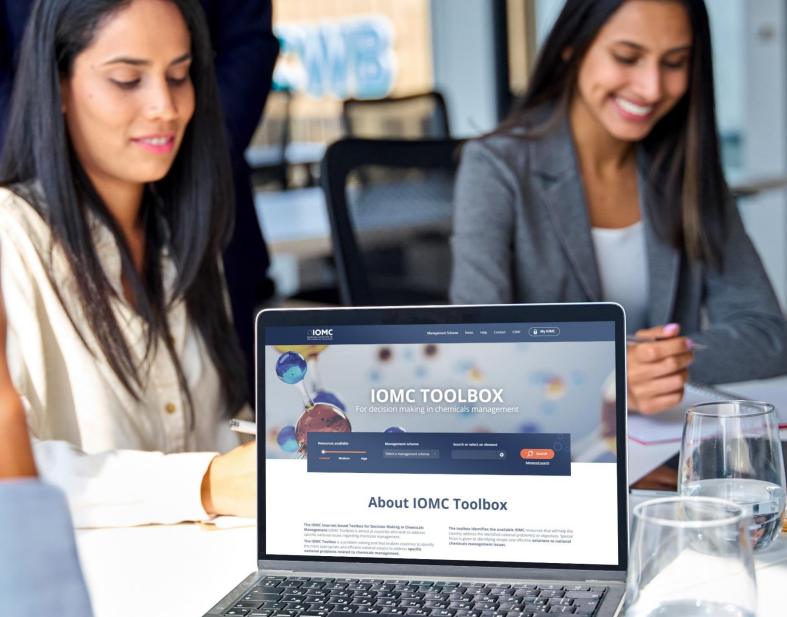
Phase IV of the IOMC Toolbox for decision making in chemicals management project aims to improve the sound management of chemicals and hazardous waste in countries worldwide, thereby contributing to the achievement and implementation of nearly all Sustainable Development Goals (SDGs), multilateral environmental agreements, and other international frameworks. This project phase focuses on enhancing IOMC Toolbox utilization and strengthening collaboration and networking. It aims to achieve its objective by:
- Updating and broadening the IOMC Toolbox;
- Improving guidance and tools, including language accessibility;
- Organizing web-based training courses; and
- Training and promotional events.
The project is funded by the European Union and runs from January 2023 to December 2025. It is implemented by seven IOMC participating organizations (POs) with WHO as the administering organization.
The Mid-Term Evaluation (MTE) assessed the project's relevance and effectiveness from January 2023 to September 2025. It followed a participatory and mixed methods approach, including analysis of the theory of change (ToC), carrying out a strategic foresight workshop, in depth interviews, an online survey, desk review and analysis of website analytics. The evaluation encountered geographic, time, budget, summer timing, low survey response rate and data availability limitations.
Key evaluation findings and conclusions
Strong Conceptual Foundation Undermined by Administrative Problems. Phase IV demonstrates strong alignment with global processes and priorities, particularly SDG 12.4, the 2023 Global Framework on Chemicals (GFC), and EU priorities. However, the project faces a serious administrative issue. The joint programme modality used by the Phase IV proved mismatched for sustained technical cooperation among seven organizations with distinct procedures.
Mixed performance across outcomes. Reasonable progress has been made on management schemes development and user engagement, but limited progress in the remainder. Shortfalls can be expected on outputs that depend on previous work, for example translations.
GFC presents an important opportunity. The GFC presents an opportunity to transform the IOMC Toolbox from a standalone capacity building initiative into a part of an integral global chemicals governance infrastructure. Existing content requires remapping and reframing in GFC terminology. The Project Management Group (PMG) has had the foresight to request POs to begin the mapping process.
Limited institutional change despite broad reach. While the project achieved verified participation across 19 countries with 229 confirmed participants in IOMC Toolbox events, evidence of meaningful outcomes remains largely anecdotal. The documented successes, appear dependent on exceptional timing rather than systematic effectiveness. Gender equality and human rights integration shows partial progress but remains fragmented without the resources for a comprehensive strategy.
Recommendations
Five recommendations were issued by the MTE.
Immediate action
R1. Secure No-Cost Extension Through Emergency Provisions.
High priority
R2. Address Administrative Bottlenecks for Phase IV: Ensure processes are more streamlined and address administrative bottlenecks. A practical suggestion is for POs to ensure reports align with donor expenditure and reporting requirements prior to submission and for the AO to vet PO financial reports more closely for compliance with donor requirements before submitting them to WHO Finance.
R3. Achieve Strategic Realignment with Global Framework on Chemicals: Should the PMG wish to go beyond mapping Toolbox content onto GFC targets in Phase IV then the project should consider creating explicit entry points that position the IOMC Toolbox as essential infrastructure for GFC Programme One on national legislation and institutional capacity building.
Medium priority
R4. Improve user experience. Redesign platform functionality to address low engagement patterns through simplified navigation, contextualized content presentation, and interactive support mechanisms.
R5. 5. Carry Out One or Two Targeted Low-Cost Interventions that Establish Gender Awareness as a Quality Improvement Rather than an Add-On. Given time and resources available in the second half of Phase IV of the project what it can do is to take one or two examples of where there is active exclusion to understand the barriers and how they could be overcome. The project could also explore if and where gender-blind language creates problems in two or three of the most used management toolkits and make targeted revisions as a pilot for doing this more widely.
Lessons Learned
L1. Training alone is insufficient to achieve better chemical management: Better chemical management depends on organizational prioritization, resource availability, and ongoing support beyond single sessions. Tools need to go hand in hand with strengthened institutions, adequate financial resources and improved enforcement capacity. Many of these are outside the control of the project.
L2. Multi-agency coordination as a double-edged sword: Multi-agency coordination to deal with sectoral gaps and overlaps, while theoretically sound and a rationale for the project, can create problems due to administrative complexity, e.g., 10-month funding delays and extended nine+ month consolidation delays significantly undermine overall project execution, timelines, and outcomes.
L3. Timing Trumps Tools: Strategic timing - aligning support with emergent opportunity for policy change – can produce more impact than when there is no policy window. The Vietnam case illustrated this: OECD conducted training precisely when the country was revising chemical management legislation, leading to policy influence. However, this success appeared exceptional rather than systematic.
L4. Embedding Over Standalone: Carrying out Toolbox activities within project, country and global processes is more likely to contribute to behaviour change because what is learned is more likely to be revisited and used when carried out in ongoing processes.
File
File