

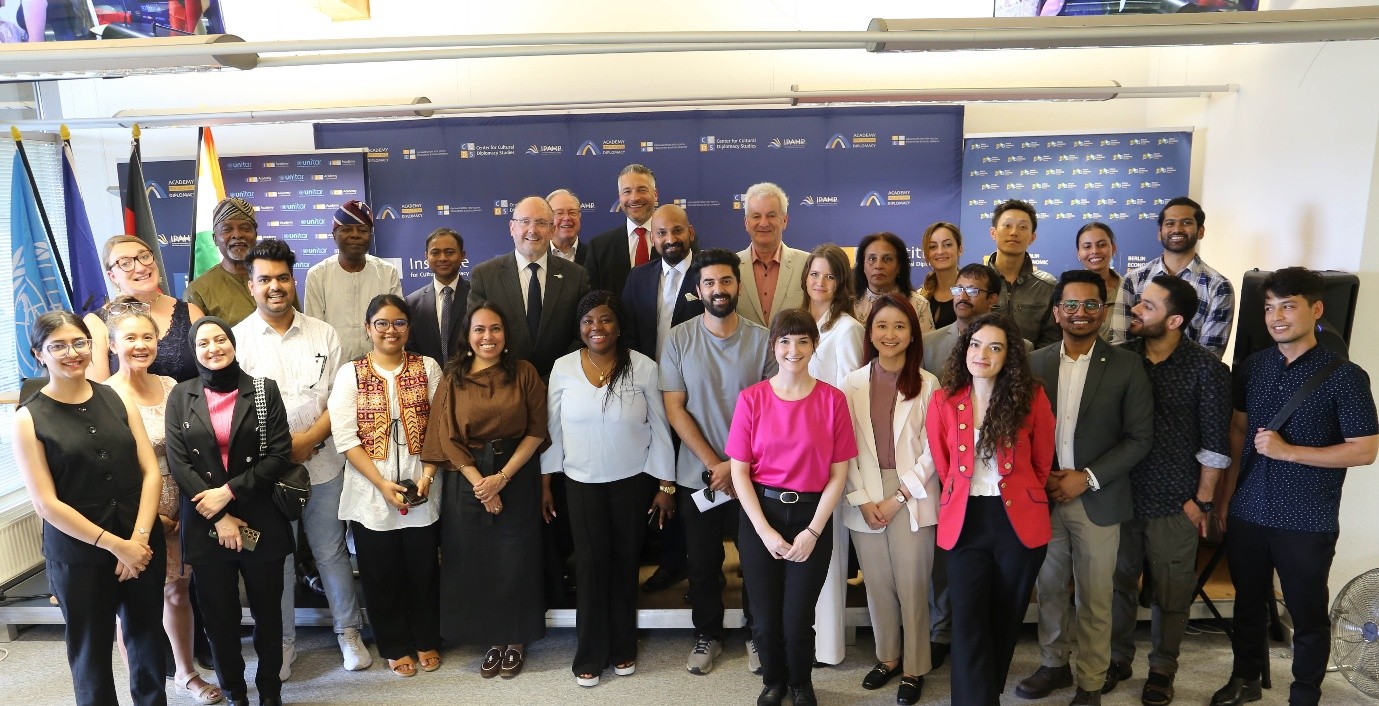
© ICD - Academy for Cultural Diplomacy.
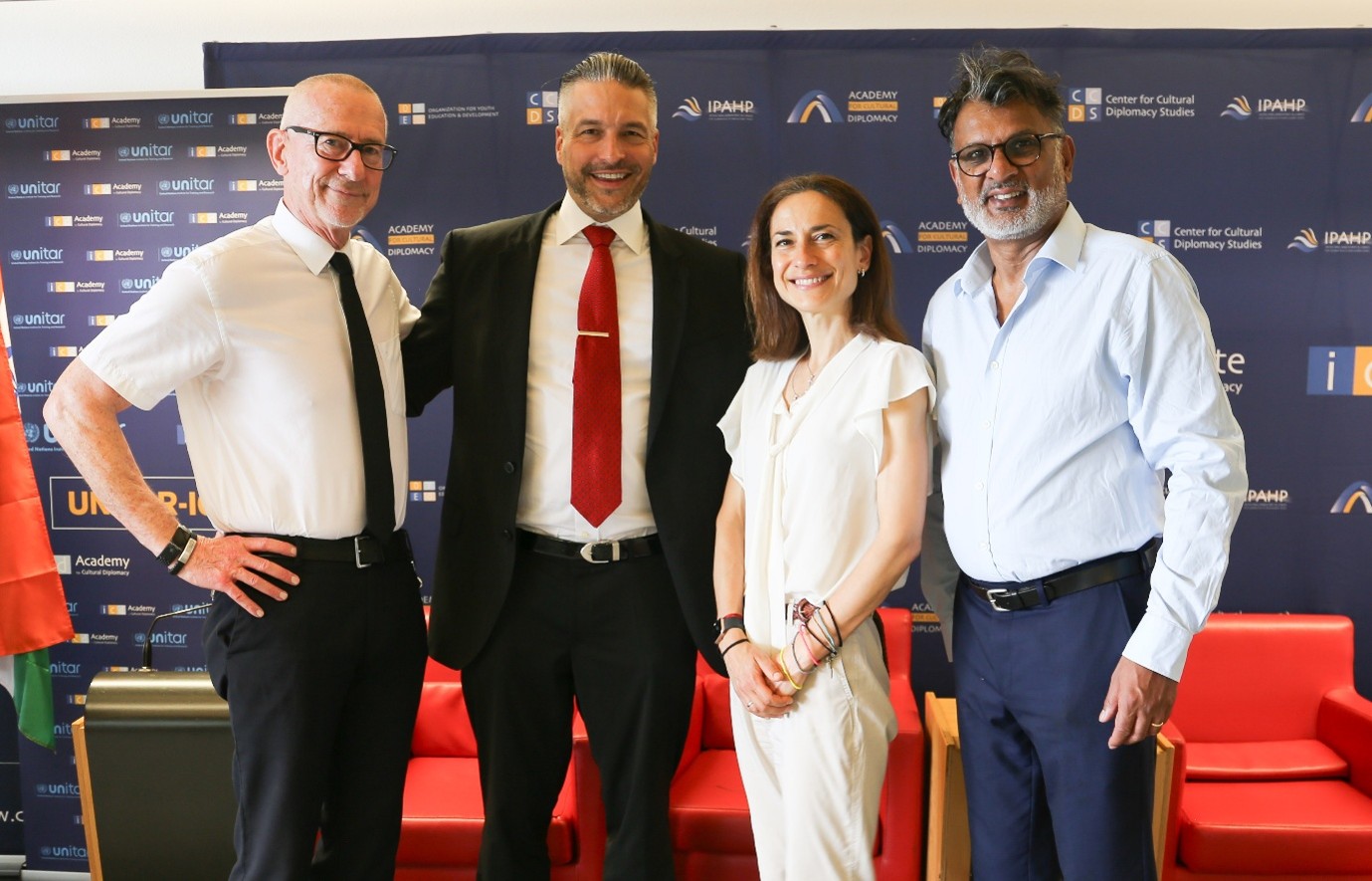
© ICD - Academy for Cultural Diplomacy.
The Academy for Cultural Diplomacy Studies (ICD) and the United Nations Institute for Training and Research (UNITAR) have partnered to deliver the Executive Diploma Programme in Cultural Diplomacy, International Relations, and Global Governance. The programme combines ICD’s academic expertise with UNITAR’s mandate to provide high-quality training in multilateral diplomacy and global governance.
This Executive Diploma offers participants a structured learning experience on the relationship between culture, international cooperation, and global governance. Through modules delivered by UN officials, diplomats, practitioners, and academics, participants gain a comprehensive understanding of the United Nations system as well as key contemporary issues shaping international relations.
The programme places particular emphasis on the role of Cultural Diplomacy in strengthening global governance. It examines how cultural exchange and intercultural understanding contribute to cooperation at the political, economic, and societal levels. Participants study both historical and contemporary applications of Cultural Diplomacy and assess its relevance to major global governance institutions, including the United Nations, the European Union, and the African Union.
Programme Information
Duration: 16 weeks
(4 weeks part-time study + 12 weeks for final assignment)
Workload: Part-time
Location: Potsdam/Berlin or Online
Modality: Blended (synchronous & asynchronous learning)
Programme Dates:
- Berlin or Online: 12-21 October 2026
- Online: 21-30 October 2026
Language: English
Fee: 1,700 EUR
Content and structure
UNITAR and ICD jointly deliver the programme, allowing participants to benefit from the expertise and methodologies of both institutions. The programme includes eight modules, of which four are delivered by ICD and four by UNITAR. All UNITAR modules are delivered on a virtual learning platform.

Module 1: History and Evolution of the field of Cultural Diplomacy
The course provides a comprehensive overview of the theory, modules, history, and evolution of cultural diplomacy as a type of activity based on the cultural exchange between peoples and nations. This module will also provide an analysis and lay the basis for an understanding of the definitions and models of cultural diplomacy and how cultural diplomacy works in practice. The historical context of various cultural diplomacy efforts (both successful and unsuccessful) is also presented, along with an analysis of how different agents (such as state actors, non-state actors, and global governance institutions) and a range of different tools (including the arts, music, sports, media, religion and interfaith dialogue) have played a role in these efforts.
Module 2: International Case studies in applied Cultural Diplomacy
The course will provide participants with an understanding of contemporary approaches to cultural diplomacy and how cultural diplomacy practices differ across the world. This module will include various case studies, a diverse array of cultural diplomacy strategies that can be applied in different settings and contexts around the world, both in the framework of bilateral and multilateral relations. The module will also analyse case studies of the practice of cultural diplomacy in the public sector, private sector, and civil society around the world. Participants will analyse these case studies with a particular focus on the target audience, methods, timescale, actors, organizations and objectives, using empirical techniques. During this module, participants will also reflect on the external factors that contribute towards a country’s approach to cultural diplomacy such as the political culture, geo-strategic location, economic structure, history, foreign policy goals and priorities.
Module 3: Future trends in International Relations & Cultural Diplomacy
This module will analyse the extent to which the process of globalisation will influence the future conduct of cultural diplomacy and international relations and will explore the role that cultural diplomacy can play in a rapidly changing world. In doing so, it will consider factors such as globalisation, geopolitical changes, climate change, world population growth, increasing inequalities between rich and poor, and global efforts to achieve sustainable development. Participants will reflect and analyse on how future trends in cultural diplomacy are linked to issues such as globalisation, multiculturalism and interdependence, as well as global governance. They will also assess new forms of cultural diplomacy for the public sector, the private sector and civil society.
Module 4: Global Governance
The module will introduce participants to the concept of global governance and to the various approaches and agendas developed in this field. This module will also offer an overview of current scholarly debates on the interdisciplinary study of global governance in the context of globalisation. It examines competing perspectives on globalisation and global governance and explores the sources and consequences of global power and authority, as well as the key actors, institutions, regimes, and norms of global governance, with practical examples and applications of these concepts as a core part of the module. Relevant concepts will be examined to assess the relative strengths and weaknesses of existing governance structures and to identify ways in which alternative forms may contribute to sustainability, with particular attention given to selected topics and global challenges such as trade and CPR, the environment, security and health.
Module 5: Introduction to the United Nations System
This module is designed to provide participants with a structured overview of the United Nations system, its historical development, legal foundations, and institutional architecture. It examines the origins and purposes of the UN Charter, the roles and functions of the principal organs, and the operation of key subsidiary bodies, funds, programmes, and specialised agencies. The module also addresses decision-making processes, peace and security mechanisms, and the UN’s financing and budgetary framework, offering historical, political, and analytical perspectives on the functioning and current challenges of the UN system.
Module 6: Introduction to the Human Rights Institutions
The module will provide participants with a structured introduction to international human rights law and the United Nations human rights institutional framework. It examines key concepts and definitions, the development of the international human rights system, and the legal foundations of human rights protection within the UN. The module presents the roles and functioning of the Office of the High Commissioner for Human Rights, the Human Rights Council, its main mechanisms including the Universal Periodic Review and Special Procedures, and the human rights treaty bodies, offering an analytical overview of how these mechanisms operate in practice.
Module 7: Crisis Management
This module will provide participants with an introduction to crisis management frameworks, leadership approaches, and risk assessment methodologies applicable across organisational contexts. It examines key theories and models of crisis management, including crisis communication, team roles and responsibilities, and decision-making under pressure. The module addresses the identification and assessment of risk, the establishment of crisis management and communication structures, and the coordination of response strategies, with a focus on leadership, resilience, and maintaining organisational continuity during and after a crisis.
Module 8: Sustainable Development Goals
This module will provide participants with an overview of the UN 2030 Agenda for Sustainable Development and the 17 Sustainable Development Goals (SDGs), examining their purpose, scope, and interlinkages. It will explore the core principles of the Agenda, including universality, inclusiveness, and the commitment to leave no one behind, as well as the economic, social, and environmental dimensions of sustainable development. Participants will be introduced to the global framework for SDG implementation, monitoring, and review, and will examine progress, challenges, and trends at the international level.
Following completion of the eight module workshops, which take place over the course of one month, participants will receive the detailed guidelines for preparing the final assignment. The assignment consists of an 8 to 10-page research paper on a topic related to the course content.
Participants will have up to three months from the conclusion of the modules to complete and submit their paper. The final assignment will be submitted to the ICD Academy for Cultural Diplomacy. Extensions may be granted in exceptional circumstances upon request.
Participants who complete all modules and submit the final assignment will receive the UNITAR-ICD Executive Diploma Certificate in Cultural Diplomacy, International Relations & Global Governance.
ALUMNI TESTIMONIAL
"Participating in this programme, has profoundly transformed my understanding of how culture intersects with global governance. The carefully designed curriculum highlights cultural diplomacy as a crucial tool for fostering international cooperation. The coursework effectively blends theory with practical insights, demonstrating how cultural engagement can tackle global challenges. Collaborating with a diverse group of professionals enriched my understanding and opened doors to invaluable networking opportunities, enabling me to explore innovative strategies in international relations. The faculty’s expertise offered insights that significantly shaped my approach to global governance and enhanced my strategic thinking. I highly recommend this programme to anyone eager to make a meaningful impact through cultural diplomacy." — Jean Marie Kouassi, Director, Academic & Community Partnerships, University of Pennsylvania; Alumnus
ABOUT UNITAR
The United Nations Institute for Training and Research (UNITAR) provides innovative learning solutions to individuals, organizations, and institutions to enhance global decision-making and support country-level action for a better future.
ABOUT ICD
The ICD Academy for Cultural Diplomacy (ICD) is a leading institute dedicated to the study and practice of Cultural Diplomacy. ICD offers graduate programmes, e-learning courses, professional development programmes, and study-abroad opportunities. Their aim is to develop and raise awareness of the theory and practice of cultural diplomacy and related fields such as global governance, international law, human rights, sustainable economies, and performing arts as well as to explore new strategies for the strengthening of intercultural relations and promoting global peace