

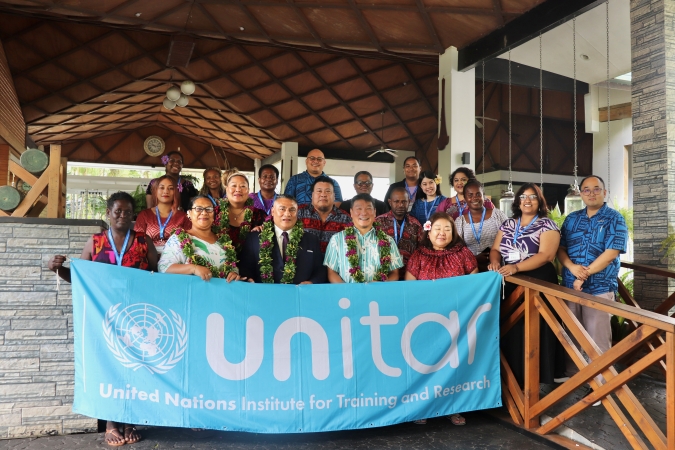
- Twelve participants from six Pacific countries gathered in Apia, for a four-day regional workshop, the final phase of the UNITAR Hiroshima Women’s Leadership in Tsunami-Based Disaster Risk Reduction for World Tsunami Awareness Day 2025, funded by the Government and People of Japan.
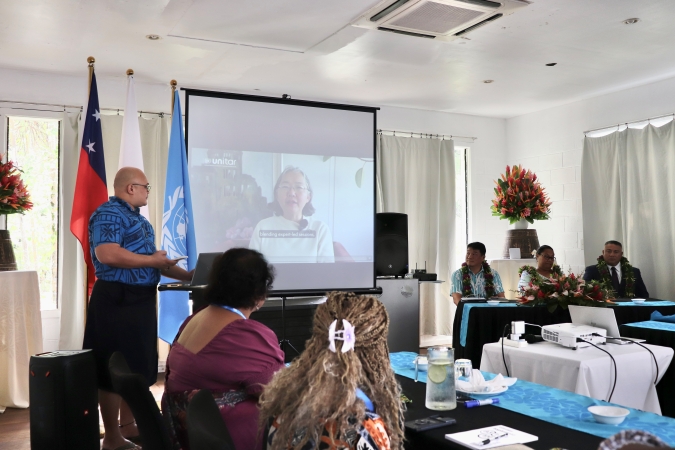
- The workshop opened on 9 March 2026 with an opening ceremony attended by participants and esteemed guests.
- The workshop builds on the online phase of the programme. Through expert-led lectures and study visits, participants will gain practical insights into women’s leadership development, disaster resilience, and disaster risk reduction in the context of economic and livelihoods.
- On 12 March 2026, participants will present their inclusive disaster risk reduction project plans, showcasing their proposed solutions tailored to the risks and needs of their communities.
UNITAR
11 March 2026, Apia, Samoa – On 9 March, the United Nations Institute for Training and Research (UNITAR) welcomed 12 emerging leaders from six countries across the Pacific Islands to a regional workshop in Apia for the “Women’s Leadership in Tsunami-based Disaster Risk Reduction for World Tsunami Awareness Day 2025” training programme. Running from 9 to 12 March, this four-day workshop is the final phase of the training programme.
The programme, financially supported by the Government and People of Japan, aims to empower participants with essential skills to develop inclusive disaster risk reduction strategies tailored to their communities. This regional workshop builds on the online phase, which ran from 10 September to 19 November 2025 and in which the participants engaged in self-paced online learning, expert webinars, and peer-exchanges to build their knowledge of disaster risk reduction and women’s leadership.
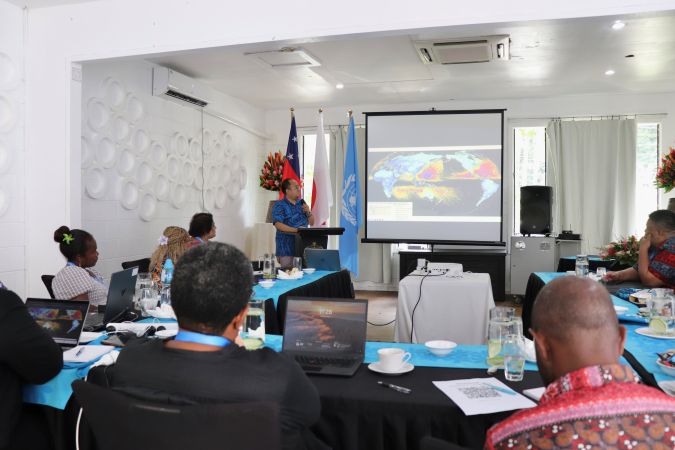
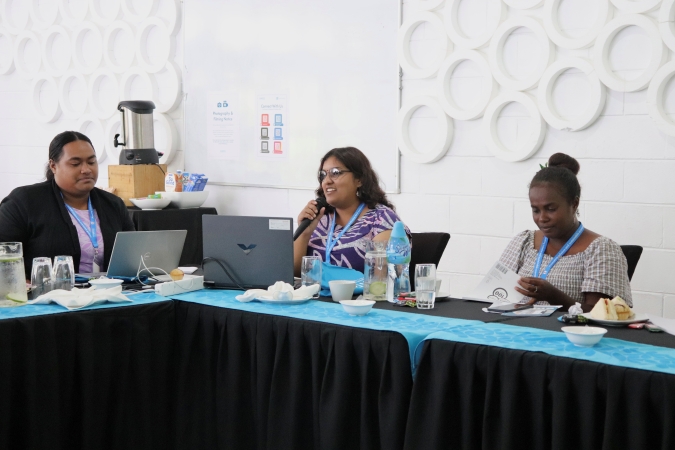
Through expert-led lectures, study tour, group exercises and discussions, participants will further deepen their knowledge and leadership in disaster risk reduction, with a strong focus on women’s leadership and inclusive approaches to building resilience across communities, local economies and livelihoods. The workshop will cover critical topics such as:
- Understanding hazards (geological, technological and hydrometeorological hazards)
- Ecosystem-based and community-based disaster risk reduction
- Leadership and management in navigating disaster risk reduction
- Pacific indigenous traditional knowledge and disaster resilience
- Post-disaster needs assessment
- Early warning systems and communications in disaster risk reduction
- Inclusivity in disaster risk reduction, with consideration to gender, persons with disabilities and other marginalized groups
The workshop highlight is a study tour to the Samoa National Emergency Operation Centre, where participants will gain firsthand insights about disaster preparedness and response efforts on the ground. They will also visit Maninoa on the southern coast, where community members will share their experiences of disasters and their survival strategies. Over the four days, the participants will incorporate what they learn to develop inclusive disaster risk reduction project plans, tailored to the risks and needs of their communities.
Opening Ceremony
UNITAR
The regional workshop kicked off with an opening ceremony, where Ms. Chisa Mikami, Head of UNITAR Hiroshima Office, emphasized the workshop’s role in empowering women and strengthening leadership networks in disaster risk reduction. She encouraged the participants to make the most of this opportunity.
I encourage you to … engage actively, share openly and learn not only from the experts but also from each other.” – Chisa Mikami, Head of UNITAR Hiroshima Office
Mr. Tomohiro Kanata, Deputy Head of Mission and Counsellor at the Embassy of Japan in the Independent State of Samoa, also attended the opening ceremony and delivered remarks to the participants.
This was followed by remarks from Ms. Fesola’i Molly Faamanatu Nielsen, ACEO of the Disaster Management Office at the Samoan Ministry of Natural Resources and Environment, who welcomed the participants to Samoa and the regional workshop.
Workshop Schedule
Some of the highlights of the workshop include:
- 9 March: Lectures and discussions on geological, technological and hydrometeorological hazards, followed by a group exercise
- 10 March: Lectures and discussions on leadership and management, indigenous and traditional knowledge in disaster risk reduction, post-disaster assessment needs, early warning systems, public awareness and the role of media in disaster risk reduction
- 11 March: Group exercise to further develop participants’ individual disaster risk reduction project plans, followed by a study tour to relevant national and community-level sites.
- 12 March: Lectures and discussions on ecosystem and community-based disaster risk reduction, panellist session on inclusivity in disaster risk reduction, followed by final presentations, where participants will present their disaster risk reduction project plans for their communities. The workshop will conclude with a closing ceremony.
UNITAR
UNITAR
About the Women’s Leadership in Tsunami-based Disaster Risk Reduction Training Programme for World Tsunami Awareness Day 2025
The Women’s Leadership in Tsunami-based Disaster Risk Reduction Training Programme for World Tsunami Awareness Day 2025 aims to equip participants with the skills to design inclusive disaster risk reduction strategies. The programme is financially supported by the Government and People of Japan.
This two-phase programme selects participants from around the world who are passionate about women’s empowerment and disaster risk reduction. Phase I consists of a three-month asynchronous online learning experience with expert-led webinars and group exercises. The Phase II invited the top 27 participants from the global cohort to the live webinar sessions and the top 12 participants from the Pacific countries to an intensive in-person workshop in Apia.
For more information, visit the programme webpage.
About UNITAR
The United Nations Institute for Training and Research (UNITAR) is a dedicated training arm of the United Nations. In 2024, UNITAR trained approximately 550,000 learners around the world to support their actions for a better future. UNITAR has a global presence, with offices in Geneva, Hiroshima, New York and Bonn and networks around the world. Find out more at unitar.org