

26 November 2026, Geneva, Switzerland – As disaster risks become increasingly complex, organizations must continually assess whether their Early Warning Systems are reaching the right people, at the right time, with actionable information. Understanding what worked, what did not, and why is essential to reducing losses and protecting communities.
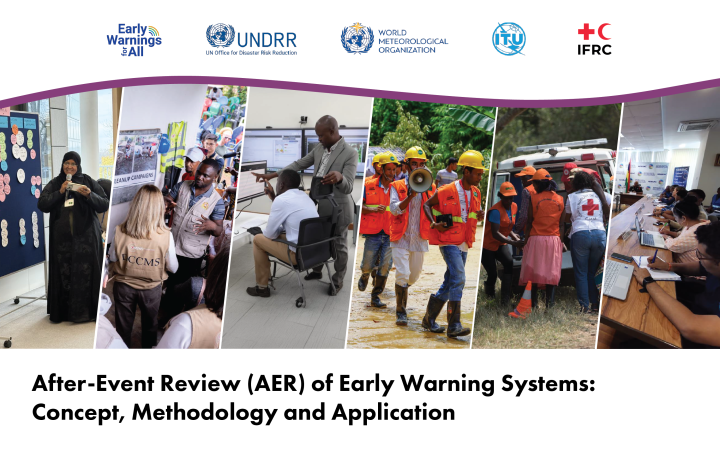
In support of strengthening capacities for assessing, reviewing, and improving the performance of Early Warning Systems, the United Nations Institute for Training and Research (UNITAR) and the United Nations Office for Disaster Risk Reduction (UNDRR) are pleased to launch the “After-Event Review (AER) of Early Warning Systems: Concept, Methodology and Application” course. AERs provide a structured process for examining how Early Warning Systems performed during a hazardous event, enabling stakeholders to identify strengths, challenges, and lessons learned.
Learn more about this course by watching the videos from UNITAR and UNDRR
Message from Ms. Michelle Gyles-McDonnough, UN Assistant Secretary-General and Executive Director of UNITAR
Message from Mr. Kamal Kishore, Special Representative of the Secretary-General (SRSG) for Disaster Risk Reduction
ABOUT THE COURSE
UNITAR
The course builds on the Methodological Guidance for Conducting After-Event Reviews of Early Warning Systems, translating key concepts and processes into an accessible learning experience for practitioners and decision makers. It provides a comprehensive introduction to the concepts, principles, and practical application of AERs. Through interactive modules, learners are guided through the stages of planning, conducting, validating, and reporting an AER process, while exploring the roles and responsibilities of stakeholders involved in reviewing Early Warning Systems.
Participants will also gain an understanding of how AERs contribute to institutional learning, stronger coordination, and more effective preparedness and response efforts across different hazard contexts. Learners will leave the course with practical knowledge that can be applied to support a more effective review process and strengthen the performance of Early Warning Systems within their own organizations.
By promoting reflection, evidence-based analysis, and stakeholder engagement, AERs help transform experience into actionable recommendations that support the continuous improvement of Early Warning Systems.