

UNITAR
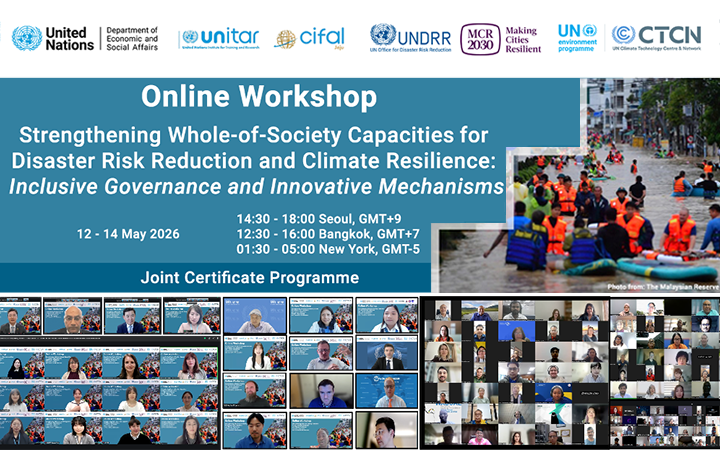
29 May 2026, Jeju, Republic of Korea – UNITAR and its International Training Centre for Authorities and Leaders (CIFAL) Jeju in collaboration with the UN Department of Economic and Social Affairs (UN DESA) and its Division for Public Institutions and Digital Government (DPIDG), as well as its UN Project Office on Governance (UNPOG), UNDRR ONEA and the Global Education and Training Institute (GETI), UNEP and its Climate Technology Centre and Network (CTCN) conducted a two-day virtual workshop titled “Strengthening Whole-of-Society Capacities for Disaster Risk Reduction and Climate Resilience: Inclusive Governance and Innovative Mechanisms”.
From 12 to 14 May 2026 focused on examining how inclusive governance, risk-informed institutions, and innovative mechanisms can advance disaster risk reduction and climate resilience, the workshop brought together 2,000 national and local government officials, disaster risk reduction and climate focal points, and civil society representatives across the Asia–Pacific region. Participants and experts shared perspectives and knowledge to inform practical actions for governments, international organizations, and local communities to implement the Sendai Framework for Disaster Risk Reduction 2015–2030 and the 2030 Agenda for Sustainable Development (2030 Agenda).
CIFAL Jeju
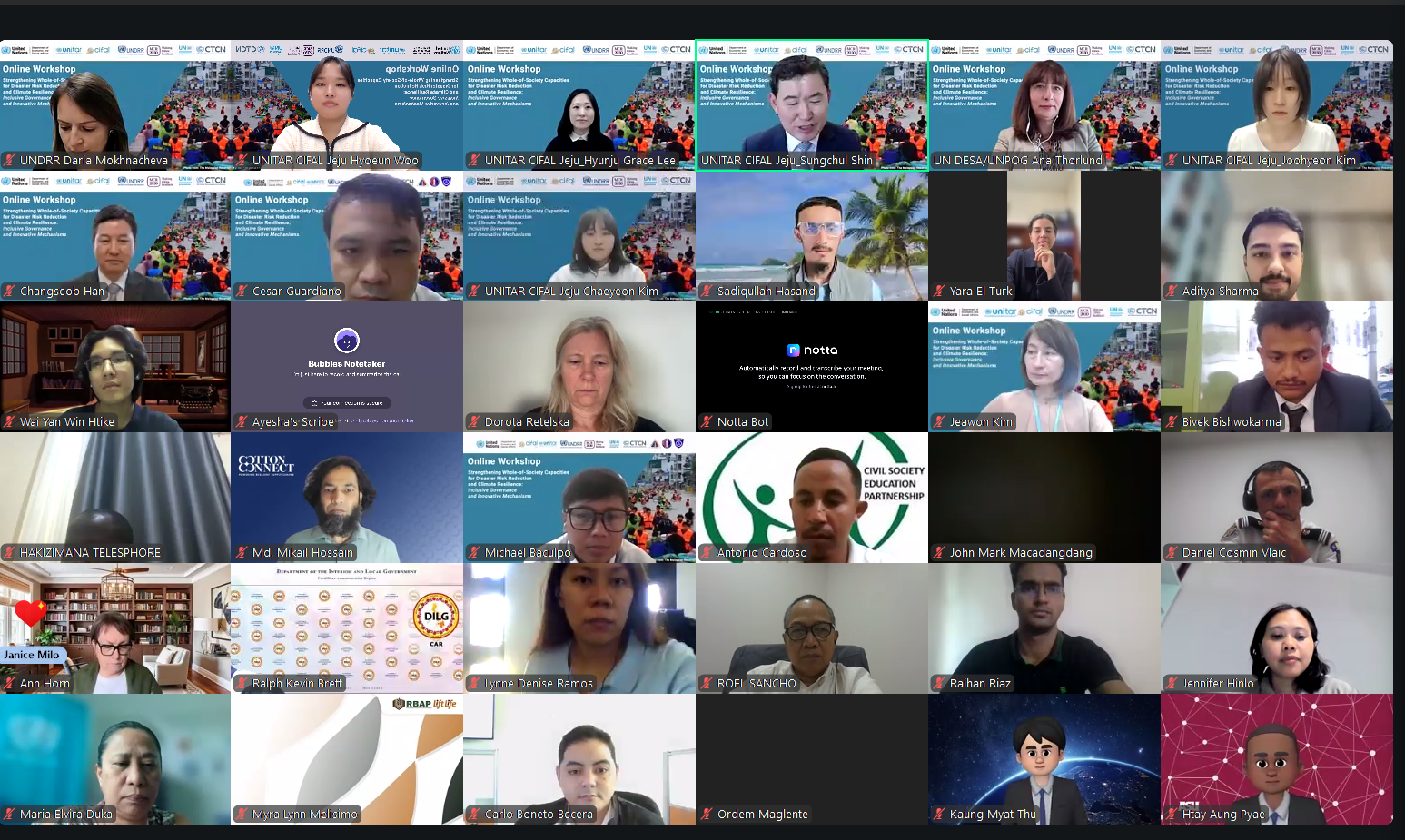
- Day 1: Experts from UNDRR ONEA GETI introduced MCR2030 tools, the Disaster Resilience Scorecard for Cities and its thematic addenda to identify gaps, prioritize actions, and ensure that local resilience strategies work for all. Experts shared experiences from cities participating in the MCR2030 initiative with conducting systematic assessments to guide long-term investments and support city-to-city learning. Mr. Sung-Chul Shin, Director of CIFAL Jeju highlighted capacity building’s role in strengthening local and national institutions across the Asia-Pacific region.
As risks become more complex and interconnected, our responses must also adapt and work better together. Every investment in resilience and every effort to strengthen it enhances prevention, reinforces preparedness, and protects those most at risk. - Amb. Sung-Chul Shin, Director, CIFAL Jeju/JITC
- Day 2: Experts from UN DESA highlighted strategic foresight as a core pillar of future-ready public governance, particularly in the face of compounding and systemic climate and disaster risks. Participants were introduced to practical tools such as horizon scanning, scenarios, futures wheels, and backcasting, and discussed how these approaches can be institutionalized within governance systems to enhance disaster risk reduction and climate resilience.
The future is not fixed or predetermined; it is shaped by today’s decisions, values, and actions.
stressed Ms. Ana Cristina Thorlund, Governance and Public Administration Expert, UN Project Office on Governance, UN DESA, UNPOG, DPIDG
- Day 3: Representatives from the United Nations CTCN, Kangwon National University AI Climate Disaster Technology Convergence Research Institute, and the Korea Institute for Industrial technology (KITECH) highlighted the decisive role of the private sector and climate technologies in closing gaps in climate resilience and finance. Presenters showcased artificial intelligence-enabled tools for climate forecasting, early warning, and decision support, emphasizing that technological innovation must be accompanied by appropriate institutional arrangements, data systems, and sustainable financing. The joint effort reflects a shared commitment to promoting risk-informed, rights-based development and building resilient and inclusive societies, in line with the United Nations mission to support green growth, human security, and the Sustainable Development Goals globally.