

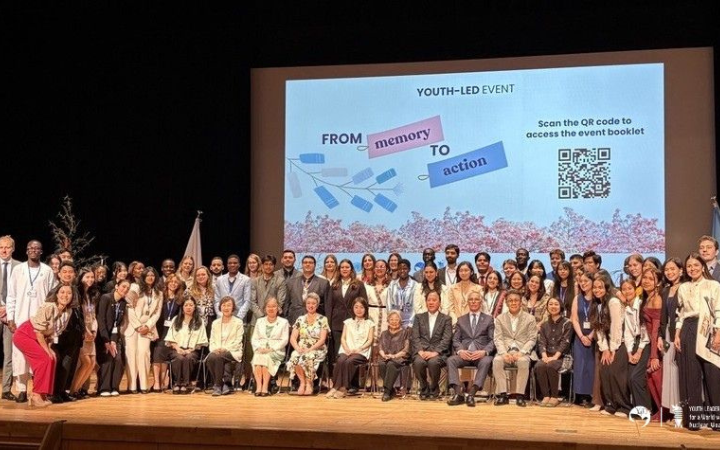
- On 3 July 2026, 50 youth leaders from 39 countries committed to act for a future without nuclear weapons at a youth conference “From Memory to Action” that they organized. The conference was held in Hiroshima, Japan, and online.
- The conference was the culminating event of the Youth Leader Fund for a World without Nuclear Weapons programme.
- As part of the programme, participants visited Nagasaki and Hiroshima, where they met hibakusha, visited symbolic sites and exchanged perspectives on nuclear disarmament with local young people.
- The Youth Leaders Fund is run by the United Nations Office for Disarmament Affairs, funded by the Government of Japan, and the programme’s study visit to Japan is implemented with UNITAR. This is the second cohort of the programme.
UNITAR
8 July 2026, Hiroshima, Japan - On 3 July 2026, 50 youth leaders from 39 countries committed to act for a future without nuclear weapons at a youth conference “From Memory to Action” that they organized. The conference was held in Hiroshima, Japan, and online, and was the culminating event of the Japan study visit of the Youth Leader Fund for a World without Nuclear Weapons (YLF) programme, which took the participants to Nagasaki and Hiroshima.
The programme, run by the United Nations Office for Disarmament Affairs (UNODA), seeks to empower young leaders to advocate for a nuclear-weapon-free world. Funded by the Government of Japan and implemented with the support of UNITAR, it offers youth peace advocates the unique opportunity to learn about nuclear disarmament, non-proliferation and arms-control principles via online courses and a fully funded in-person study visit to Hiroshima and Nagasaki. This was the second cohort of the Youth Leader Fund, following the first cohort of 2023-2024.
Youth Conference “From Memory to Action”
The youth conference focused on storytelling and citizen journalism to preserve the legacy of hibakusha (atomic bomb survivors), amplify diverse voices and inspire future generations to support nuclear disarmament. The 50 Youth Leader Fund participants were joined by a multinational group of 50 young persons based in Japan (the “Youth Leader Fund Japan cohort”), UNITAR Hiroshima Youth Ambassadors, Hiroshima Peace Volunteers (volunteer guides at the Hiroshima Peace Memorial Museum and Park), and international experts from the field of nuclear disarmament.
The Youth Leader Fund participants began preparing the conference well before the Japan study visit. In teams, they managed the event and designed and moderated the panel discussion, which explored how past experiences and stories can shape present actions and influence the global approach to nuclear issues. They invited distinguished guests as panellists, including:
- Ambassador Juan Carlos Ojeda Viglione, Secretary-General of the Agency for the Prohibition of Nuclear Weapons in Latin America and the Caribbean
- Professor Kazuko Hikawa, Research Center for Nuclear Weapons Abolition, Nagasaki University
- Ms. Koko Kondo, hibakusha and peace activist
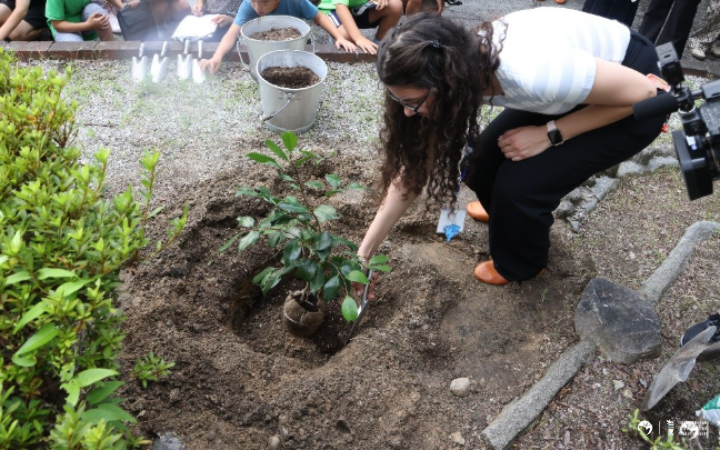
Other teams made a handbook advocating for youth engagement, created an exhibition of artwork, videos, haiku, animation and comics about nuclear disarmament, designed a mascot for the event and created goods, coordinated a hibakujumoku (trees that survived the atomic bombing) planting event, and developed a podcast and shared posts on social media to raise the visibility of the programme.
During the programme, Ms. Asaka Shirai delivered a short concert with the hibaku violin, and Ms. Mayu Seto sang a song that she created inspired by hibakusha testimonies.
The youth conference began with a video message by former Prime Minister Fumio Kishida, who had announced the creation of this Youth Leader Fund initiative in 2022. He emphasized the importance of preserving the memory of the Hiroshima and Nagasaki, especially as global security and the situation regarding nuclear weapons are becoming increasingly difficult and complex.
The event served as a platform for intergenerational dialogue, youth-led engagement, and creative expression, grounded in collective memory and diverse regional perspectives on nuclear risks and disarmament.
Learning in Nagasaki and Hiroshima
The conference built on the learnings and experiences from the study visit to Nagasaki and Hiroshima. In the two cities, participants learned from hibakusha, visited symbolic sites and institutions and exchanged perspectives on nuclear disarmament with local young people. These interactions provided participants with deep insights into the humanitarian and environmental consequences of nuclear weapons use, while fostering a network of future leaders committed to advocating for a nuclear-weapons-free world.
UNITAR
Visit in Nagasaki
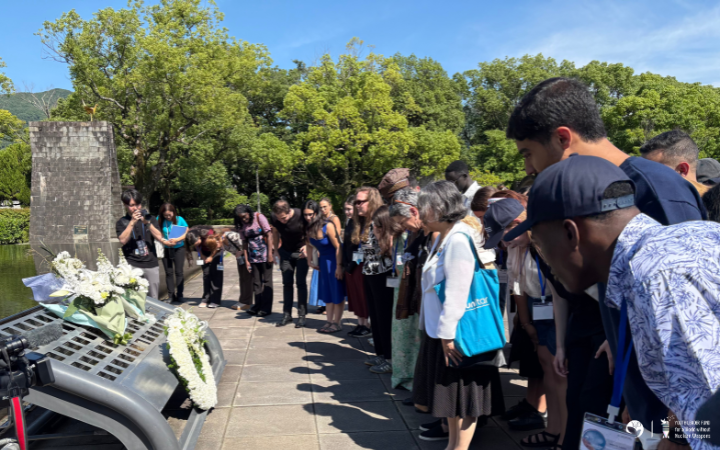
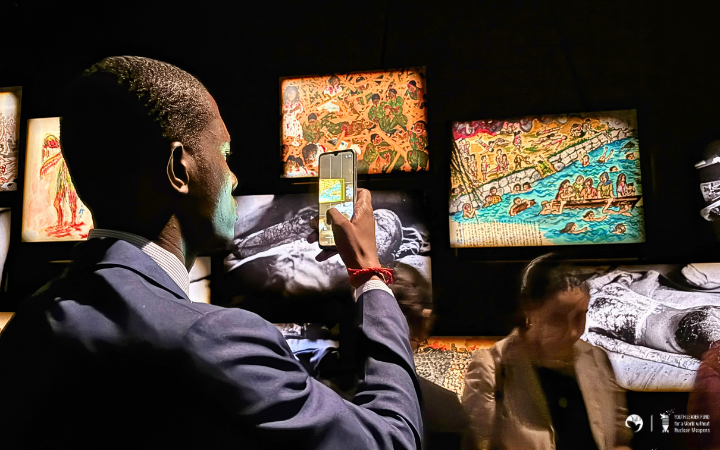
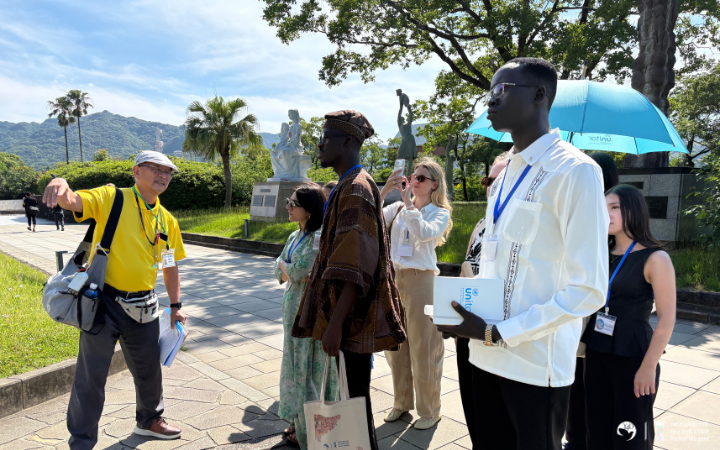
The study visit began in Nagasaki on 29 June, where participants were welcomed by State Minister for Foreign Affairs Ayano Kunimitsu via video message, Nagasaki Governor Ken Hirata and Mayor Shiro Suzuki. The youth participants visited the Peace Park and the Nagasaki Atomic Bomb Museum, offered flowers in memory of the victims of the atomic bombing and met with hibakusha Ms. Teruko Yokoyama and Dr. Masao Tomonaga, who shared their personal experiences as well as a medical perspective on the effects of radiation.
On 30 June, the participants also met the Nagasaki Youth Delegation, a group of young people chosen each year by the PCU Nagasaki Council for Nuclear Weapons Abolition as official peace messengers working towards nuclear weapons abolition. The young people discussed the impact of storytelling and how narratives can contribute to change for a world without nuclear weapons.
UNITAR
Visit in Hiroshima
The participants proceeded to Hiroshima, where they were welcomed by Hiroshima Governor Mika Yokota on 1 July and Mayor Kazumi Matsui on 2 July. Highlights of the Hiroshima visit include:
- Welcoming by Governor Yokota to Hiroshima
- Offering flowers to the atomic bomb victims
- Learning about the environmental impact of the bombing through hibakujumoku from the Green Legacy Hiroshima initiative
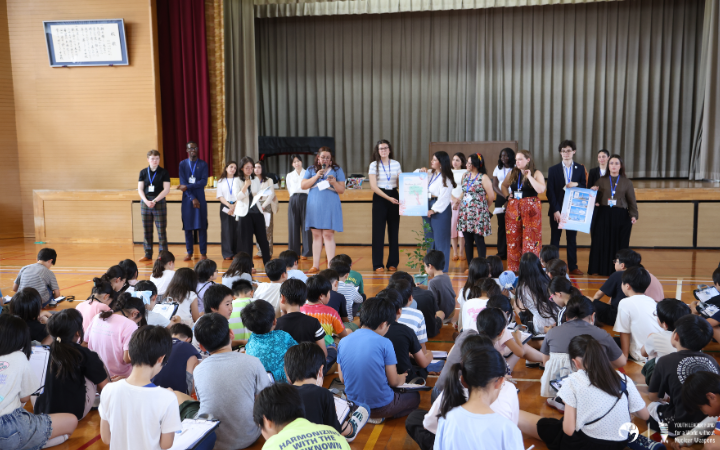
- Planting a hibakujumoku at Senda Elementary School and engaging with the students
- Meeting hibakusha Ms. Keiko Ogura, who shared her experiences before and after 6 August 1945
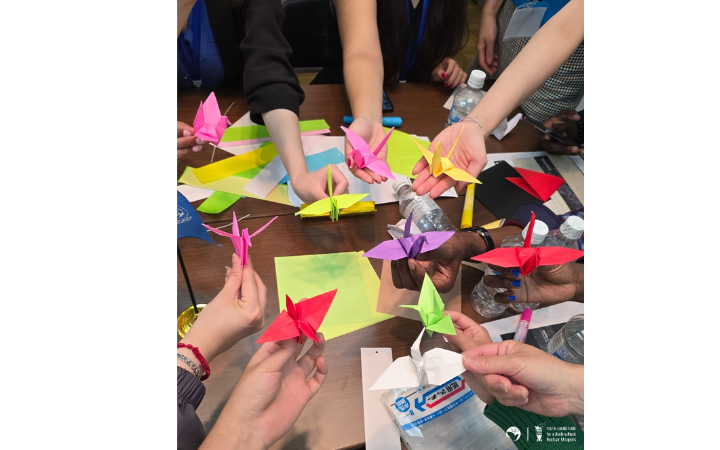
- Exchanging with Hiroshima Peace Volunteers their aspirations and commitment to advancing the nuclear disarmament agenda and taking part in a cultural workshop run by the Hiroshima Peace Volunteers for Tanabata (“star festival”)
- Learning about Hiroshima’s recovery and resilience through visits to the WoodEgg Okonomiyaki Museum, the NGO ANT-Hiroshima, and the Hiroshima Peace Media Center at the local daily newspaper Chugoku Shimbun
In parallel, the “Japan cohort” of the Youth Leader Fund arrived in Hiroshima and expanded their knowledge of nuclear weapons through visits to the Peace Park guided by 2026 UNITAR Hiroshima Youth Ambassadors. All joined the youth conference.
At the end of the study visit, Under-Secretary-General and High Representative for Disarmament Affairs Ms. Izumi Nakamitsu offered her encouragement in a video message.
[The Youth Leaders Fund] reinforces a vision of disarmament and security that is human-centred, sustainable, and informed by the enduring lessons of nuclear weapons use. [The] participants are not merely observers from a distance, but active contributors to disarmament advocacy and discussions.” Izumi Nakamitsu, Under-Secretary-General and High Representative for Disarmament Affairs.
With the support of partners including the Hiroshima City and Prefectural Governments, the Nagasaki City and Prefectural Governments, and the Hiroshima Peace Culture Foundation, the programme fostered leadership and advocacy skills among youth, particularly in the field of nuclear disarmament.
The network provided by the programme was essential, because it's important to share ideas. I had this goal in my mind but didn't know how I was going to reach it. Coming here and brainstorming ideas — you need that interaction with others who share the same interests as you to get the best ideas, in my opinion - Lucy Wilson (United Kingdom), a participant of the Youth Leader Fund for a World without Nuclear Weapons (YLF) programme.
What I took away from the two cities was a sense of both nostalgia and hope. I had learned about Hiroshima and Nagasaki through the online training. However, coming here in person, visiting the cities where the bombings occurred, and walking through the museums gave me a much deeper understanding of what happened. Seeing the artifacts, images, and videos that documented and recreated those events brought me much closer to the reality of the incident. – Aminu Brahim (Ghana), a participant of the Youth Leader Fund for a World without Nuclear Weapons (YLF) programme,
The over-100 participants established a robust global youth network dedicated to advancing nuclear disarmament. Despite the slow global progress and setbacks towards nuclear disarmament and non-proliferation, these emerging leaders offer hope for a future – where they will communicate, collaborate and pursue solutions to achieve a world without nuclear weapons through lasting friendship, trust and peace.
UNITAR
UNITAR
UNITAR
UNITAR
About the Youth Leaders Fund for a World without Nuclear Weapons (YLF)
The Youth Leader Fund for a World Without Nuclear Weapons is a programme of the United Nations Office for Disarmament that seeks to empower young leaders to advocate for a nuclear-weapon-free world. The programme gives youth peace advocates the unique opportunity to learn about nuclear disarmament, non-proliferation, and arms control principles via online courses and a fully funded in-person study visit to Hiroshima and Nagasaki. This programme launched in 2023 and is generously funded by the Government of Japan. UNITAR supports the Youth Leader Fund as an implementing partner and organized the study visit to Hiroshima and Nagasaki.
About UNITAR
Established in 1965, the United Nations Institute for Training and Research (UNITAR) is the dedicated training arm of the United Nations. Its mission is to strengthen knowledge and skills through high-quality training, research and innovative learning solutions.
Through strategic partnerships and a global learning platform, UNITAR builds skills of individuals, and enhances capacities of institutions and organizations, particularly those in vulnerable contexts, to accelerate progress towards the 2030 Agenda for Sustainable Development and the Pact for the Future. www.unitar.org