

A Network with Purpose
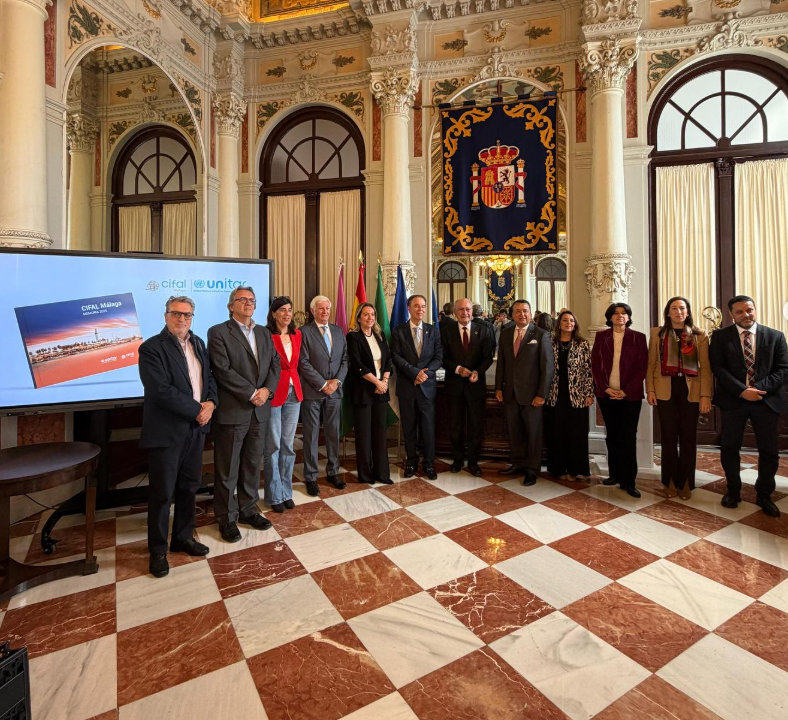
27 March 2026, Geneva, Switzerland - CIFAL Málaga is one of the 32 UNITAR-affiliated training centres part of the CIFAL Global Network operating across 5 continents. Its mandate is to develop and strengthen human capacities to better address development challenges. CIFAL centres function as knowledge transfer hubs, connecting public institutions, private sector actors, and civil society around shared development challenges.
In 2025, CIFAL Málaga organized or participated in 114 activities, reaching 3,170 people directly, accounting for more than 1057 hours of training hours. These weren't confined to seminar rooms or online platforms, they extended into the streets, schools, and civic spaces of the city itself. Women represented 51% of the total beneficiaries whereas men 49%. Moreover, the level of satisfaction of the aforementioned activities reached 92%.
Thematic Strategy
The centre's thematic focus spans several interconnected domains. Sustainability Learning sits at the core, encompassing training on the SDGs, ESG criteria: Environmental, Social and Governance standards, and global citizenship. This is complemented by work on Public Policy and Governance, including international relations and civic participation. The centre also maintains active programmes in infrastructure and economic development, covering smart cities, mobility, road safety, sustainable tourism, and technology and innovation, with a particular focus on how digital tools can accelerate development outcomes.
What makes this breadth coherent is the centre's underlying conviction: that no single pillar of sustainable development stands alone. Climate resilience requires good governance. Inclusive cities require safe mobility. Democratic participation requires an educated, engaged citizenry. CIFAL Málaga designs its programmes with those connections in mind.
Excellence in the Virtual Classroom
One of the centre's most significant achievements in 2025 has been the establishment of its Virtual Classroom as a genuine benchmark for academic excellence. Among its standout training offerings, a hybrid course on Sustainability and Multilateralism offered participants a rigorous, applied understanding of the 2030 Agenda. Funded by the Andalusian Agency for Development Cooperation, it reached professionals across multiple countries and sectors.
A second flagship programme on ESG Criteria in Public Management was developed in collaboration with the University of Málaga, targeting decision-makers who need to integrate environmental and social considerations into the policies they design and implement. And through programmes like "Slow Tourism Strategies," presented at a summit in Costa Rica, the centre trained professionals from more than ten countries on sustainable approaches to one of the world's most economically significant industries.
More than training courses, they are carefully designed learning experiences, built around real policy challenges, delivered by practitioners who understand both the theory and the terrain. Perhaps, the clearest sign of CIFAL Málaga's maturity is its growing capacity to lead, not just participate in, international consortia. In 2025, the centre coordinated two major strategic initiatives that reflect the breadth of its expertise.
The RETO Project focused on analyzing and developing strategies to counter hate crimes and hate speech, an issue of urgent relevance across Europe and beyond. The ACTIVATE initiative, meanwhile, worked transnationally to strengthen youth participation in democratic life, addressing one of the most persistent challenges facing European societies: how to reconnect younger generations with the institutions that shape their futures.
CIFAL Málaga
A City Engagement, not just a Training Centre
At FITUR 2025, Spain's major international tourism fair, the centre reinforced its cooperation agenda on sustainable tourism across Ibero-America and presented a new alliance with the Government of Melilla around the Amazigh Chair. At the Málaga Hackathon, co-organized with Oracle, young people gathered to tackle sustainability challenges through practical innovation. New institutional agreements were signed with partners including the Alliance for Regenerative Innovation and the Association of Local Police Chiefs of Andalusia, expanding the centre's reach into road safety and public security.
The centre also deepened its commitment to education across all age groups. Pedagogical workshops brought the SDGs into the classrooms of Málaga's schools, supported by the City Council. The "Generación Acción" programme offered civic formation and democratic education for secondary school students. And at the Casita del Jardinero, the centre's dedicated space for older adults, workshops continued to provide meaningful lifelong learning opportunities for the city's senior population.
Looking Forward
CIFAL Málaga operates through a network of partners that spans the public and private sectors, from the Málaga City Council and the Provincial Government to Unicaja Banco and Microsoft. This diversity of support is not just financial; it brings different kinds of expertise, reach, and legitimacy to the centre's work.
A proactive communications strategy has run alongside all of this, designed not only to inform but to position Málaga itself as a laboratory for social innovation, a city where global challenges meet local solutions, and where transparency and sustainability are not just aspirations but institutional commitments.
As Javier González de Lara y Sarria, President of the Confederation of Employers of Andalusia, put it, CIFAL Málaga functions as a meeting place that transforms global challenges into local opportunities, demonstrating that cooperation and knowledge are the foundations on which a more just and sustainable future is built.
In 2026, the work continues.