
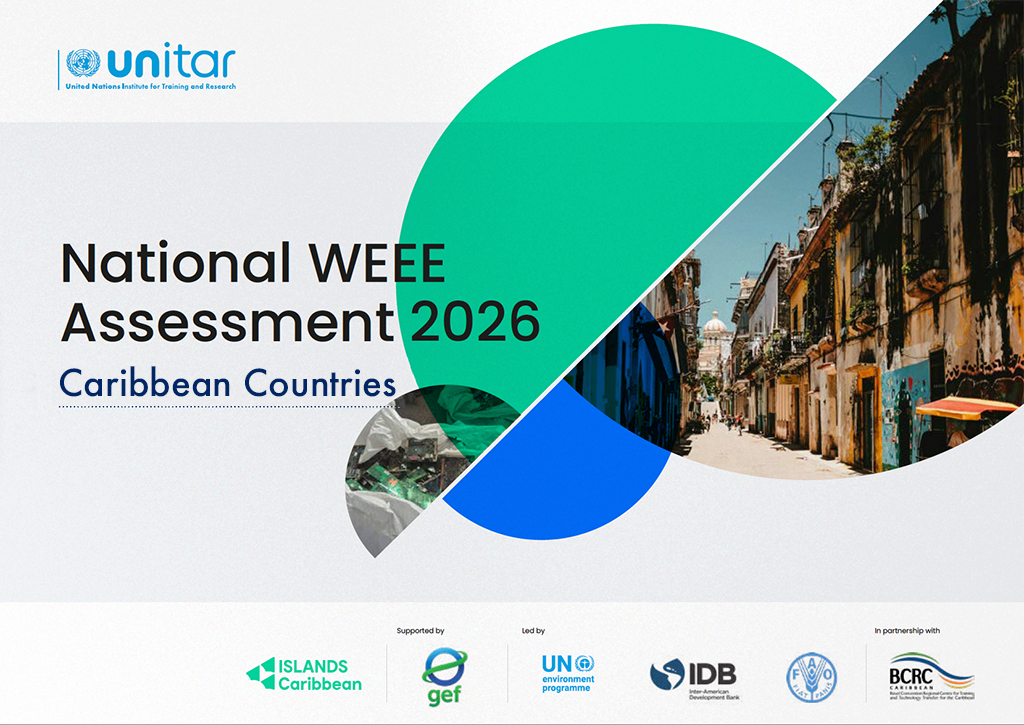
20 October 2026, Geneva, Switzerland – Eleven Caribbean countries now have national assessments of electronic waste (e-waste) and the systems available to manage it. The reports provide a country-specific starting point for decisions on collection, treatment, financing and policy.
The assessments cover Antigua and Barbuda, The Bahamas, Barbados, Belize, Cuba, Dominica, Guyana, Saint Kitts and Nevis, Saint Lucia, Suriname, and Trinidad and Tobago.
Prepared by UNITAR’s Sustainable Cycles Programme (SCYCLE) with support from the Suriname Waste Management Foundation (SUWAMA) and in partnership with the Basel Convention Regional Centre for the Caribbean (BCRC-Caribbean), the reports were developed under the Global Environment Facility-funded ISLANDS Programme, implemented by the United Nations Environment Programme (UNEP). BCRC-Caribbean served as the regional executing partner.
The assessments estimate how much electrical and electronic equipment enters each national market and how much e-waste it generates. They also examine available information on collection and treatment, economic conditions, legislation and the institutions involved.
This country-specific approach identifies national gaps and opportunities rather than applying a single model across all 11 countries.
The work extended beyond the publication of the reports. Training also covered the methods and tools used in the assessments, including how to estimate equipment placed on the market and e-waste generated, examine economic impacts and the value of materials or components recovered from discarded equipment, and consider how evidence can inform legislation and other measures.
By combining national evidence with practical knowledge of the assessment methods, the work provides a basis for countries to keep their data current as markets and waste flows change and to use that evidence when developing e-waste policies and management systems.
The national e-waste assessments are available at: https://ewastemonitor.info/