

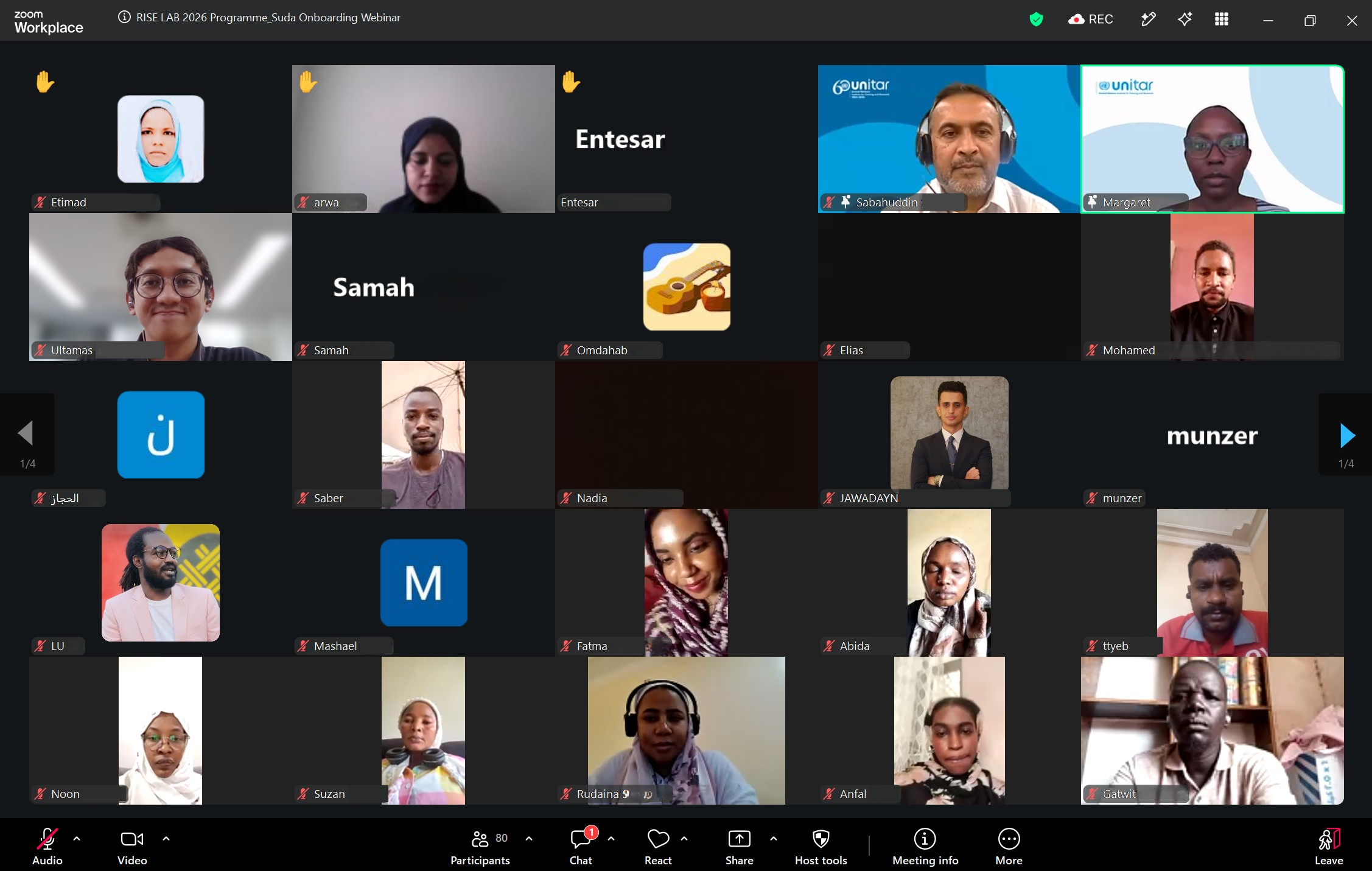
- On 8 July 2026, 221 conflict-affected women and internally displaced persons in Sudan embarked on the UNITAR Sudan RISE Lab 2026 entrepreneurship and agribusiness training.
- The free programme is funded by the Government and People of Japan and will deliver training in English and Arabic to improve accessibility for vulnerable communities.
- Through three progressive phases, participants will build skills in entrepreneurship, food security, climate-smart agribusiness and financial management, to rebuild livelihoods and reduce dependence on humanitarian assistance.
- Participants will learn through self-paced online lessons, webinars, practical assignments and discussion forums, with offline access for those with limited internet connectivity.
- The programme aims to empower conflict-affected women and displaced persons as future entrepreneurs and innovators who can contribute to local recovery and sustainable food systems.
UNITAR
30 July 2026, Hiroshima, Japan – On 8 July 2026, 221 conflict-affected women and internally displaced persons in Sudan began the United Nations Institute for Training and Research (UNITAR) Sudan Resilient Ideas for Sustainable Entrepreneurship (RISE) Lab 2026: Co-creating Sustainable Agricultural and Livelihood Solutions Through Training and Capacity-Building. The programme seeks to provide participants with practical skills and knowledge to rebuild their livelihoods, strengthen household food security and develop sustainable income-generating initiatives in a context marked by conflict, displacement and economic uncertainty.
Funded by the Government and People of Japan and offered free of charge, the programme will take participants through three progressive phases, from July 2026 to February 2027. Participants will build their foundational knowledge in food security, entrepreneurship and agribusiness in the first phase, and then apply the theory to develop business ideas and solutions connected to real needs in their communities in the second. In the final phase, they will receive mentorship and join experiential learning opportunities to test, refine and expand their ideas.
In emergency and conflict-affected settings, practical skills and access to markets can be essential assets for survival and recovery. Through training in entrepreneurship, food security, climate-smart agribusiness and business management, participants will be supported to identify viable opportunities, restore productive activities and reduce their dependence on uncertain humanitarian assistance.
The First Phase: Building Foundational Knowledge
A central objective of the first phase is to help participants identify a concrete, evidence-based problem or opportunity. They will explore interconnected areas including:
- Food security and agricultural value chains
- Entrepreneurial mindset development
- Identification of problems and business opportunities
- Sustainable and scalable enterprise development
- Financial management
- Digital entrepreneurship
- Market research and problem validation
Learners will conduct structured market research, assess feasibility and use measurable information to better understand the scale and significance of the issue they wish to address. This work will provide the foundation for developing and testing solutions for those who continue on to the later phases of the programme.
Delivering effective and relevant training in contexts marked by conflict and instability requires thoughtful design. To make the programme more accessible to more communities, it will be delivered both in English and Arabic. The programme uses a mobile-first learning platform, recognizing that internet connectivity may be limited or unstable for some participants, allowing participants to complete short lessons at their own pace, as well as download content for offline use.
To keep the training engaging, the online learning will be combined with interactive webinars, practical assignments, discussion forums, videos and additional resources. Field practitioners, coaches and UNITAR programme alumni from Arabic-speaking countries will be engaged alongside international experts to contribute regional knowledge, language support and practical guidance throughout, helping participants take the theory and apply it to local practice.
Strong Interest from Day One
Already from day one, participants showed their strong interest in how the programme could support their practical and professional development. Many expressed their desire to strengthen both their soft skills, such as communication, leadership and teamwork, and their technical skills in agribusiness, business planning and market analysis. Participants were also keen to understand how they could connect with business networks, entrepreneurship hubs, mentors and potential investors, and how they could present and pitch their ideas more effectively.
During the launch session, participants asked how the programme could help them strengthen business-planning, market-analysis, communication and leadership skills. Questions also focused on mentorship, access to business networks and developing business ideas suited to disrupted markets and limited access to finance.
Through RISE Lab 2026, UNITAR aims to support conflict-affected women and displaced persons in developing practical entrepreneurship skills and pursuing locally relevant livelihood opportunities. The programme will continue until February 2027, with selected participants progressing from foundational learning to business development, mentorship and experiential learning.
About UNITAR
Established in 1965, the United Nations Institute for Training and Research (UNITAR) is the dedicated training arm of the United Nations. Its mission is to strengthen knowledge and skills through high-quality training, research and innovative learning solutions.
Through strategic partnerships and a global learning platform, UNITAR builds skills of individuals, and enhances capacities of institutions and organizations, particularly those in vulnerable contexts, to accelerate progress towards the 2030 Agenda for Sustainable Development and the Pact for the Future.