

- Indrani P. Thuraisingham, Vice President and Legal Advisor of the Federation of Malaysian Consumers Associations (FOMCA), participated in Cohort 1 of the Pathway to Prosperity Programme, powered by Google and implemented by the Division for Prosperity at the United Nations Institute for Training and Research (UNITAR).
- A community leader and grassroots consumer advocate, Indrani joined the programme to close a critical knowledge gap. As Selangor positioned itself to become ASEAN's premier data centre hub, she needed to understand the infrastructure reshaping her constituents' lives.
- Since completing the programme, Indrani has fundamentally reoriented her advocacy work, co-developing an AI-powered digital carbon footprint visualiser as a capstone project and using newly acquired technical fluency to influence Budget 2027 policy recommendations at the national level.
- Her story is one of community leadership that reaches all the way to the legislature, a powerful example of learning translating directly into policy change.
UNITAR
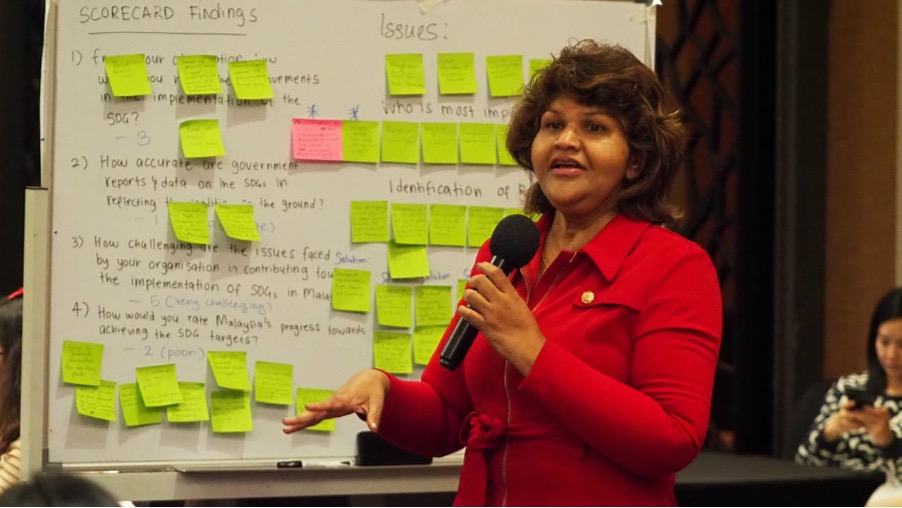
June 2026, Geneva, Switzerland — As Vice President and Legal Advisor of FOMCA, Indrani P. Thuraisingham days are usually built around consumer grievances, policy analysis, community outreach, and ensuring that ordinary Malaysians are not left behind as the country accelerates into its digital future. It was exactly this background that brought her into a room full of like-minded, enthusiastic learners and mid-career professionals comprising Cohort 1 of the Pathway to Prosperity Programme.
I feel I am helping ensure that Selangor's digital boom doesn't come at the cost of our local environment or grid stability. We are laying the groundwork to empower everyday Malaysians to be active participants in a green transition."
– Indrani P. Thuraisingham, Cohort 1, Pathway to Prosperity Programme, Vice President and Legal Advisor, Federation of Malaysian Consumers Associations (FOMCA)
Indrani started the programme with a surface-level understanding of AI tools as a feature on a smartphone and data centres as air-conditioned warehouses. Her motivation to sign-up was specifically to bridge the gap between consumer rights and complex digital infrastructure "As Malaysia, especially Selangor, gears up to become ASEAN's premier data centre hub," she reflected, "I wanted to understand the structural, environmental, and economic costs of the 'cloud' so I could better advocate for sustainable consumer policies."
WHEN A FORMULA CHANGES EVERYTHING
UNITAR
The learning that was an “absolute eye-opener” was a formula. The programme's sessions on Carbon Usage Effectiveness (CUE) and Power Usage Effectiveness (PUE) made the mathematical link between CUE and the Grid Emission Factor (GEF) visible. "It took abstract technical jargon," Indrani said, "and turned it into a tangible math problem that directly impacts our environment."
The "wow" moment came when she traced that formula to its human end. As a consumer advocate, she and her colleagues had always campaigned around resources like water usage, plastic waste and petrol. But nobody was talking about energy-intensive cloud backups. It made her realise, “digital consumption is environmental consumption.”
What followed was both a personal and professional shift in perspective. Personally, Indrani now consciously delays large, non-urgent cloud backups and data-heavy phone updates to off-peak grid hours, when solar or cleaner energy sources are more available. Professionally, she began reading tech policy proposals not just through the lens of data privacy, but through the lens of resource and energy equity. These small acts of change mark her as a proactive practitioner, one who pushes thinking well beyond the surface.
FROM CAPSTONE TO CAMPAIGN: THE DIGITAL CARBON FOOTPRINT VISUALISER
UNITAR
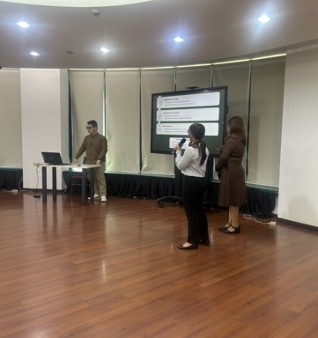
The programme's capstone structure gave Indrani's newly formed instincts a concrete outlet. Her team designed From Click to Climate: The Digital Carbon Footprint Visualiser, an AI-driven dashboard, conceptually modelled on TNB's household smart meters, that translates a consumer's real-time device usage into a direct carbon footprint reading. The aspiration was if a Malaysian consumer uses an AI tool, the visualiser would tell them, "Your device emitted 0.8kg of CO₂ today, equivalent to driving 3km in a petrol car." She further added, “As a consumer advocate, I am using this architectural framework to push for "demand-shifting" models in consumer tech.”
The process of building her capstone project also exposed a structural problem that real-time CUE data from data centres does not currently exist and the disclosures are annual or quarterly at best. Since discovering this gap, it has become the focus of Indrani's legislative ambitions. “While the tech is ready,” she noted, "our policy frameworks still need to catch up." She hopes to utilise this shift in perspective as a starting point to push for mandatory real-time carbon disclosures from tech providers.
ADVOCACY THAT REACHES THE LEGISLATURE
The most consequential change since the programme has been Indrani's expanded reach within policy spaces. Because she can now speak credibly to PUE targets, grid emission factors, and schemes like DESAC, she is being asked to draft recommendations for the government's upcoming Budget 2027, from a civil society and consumer perspective. The programme enabled Indrani to reposition FOMCA as a voice capable of leading conversations on "Beyond GDP" metrics that measure citizen wellbeing against the costs of digital development.
She has also carried this knowledge outward through her networks, demystifying ‘the cloud’ for fellow activists and community organisers, and integrating digital sustainability into FOMCA's upcoming national policy dialogues and community workshops.
Her next goal is to push the Digital Carbon Footprint Visualiser from a conceptual project into a legislative instrument, and she is unambiguous about what that looks like in practice.
"I intend to advocate for legislative measures that make real-time carbon disclosures mandatory for tech providers — to see how a simple 'AI carbon score' can nudge millions of Malaysians toward greener digital habits.”
– Indrani P. Thuraisingham
Indrani's story connects directly to SDGs 7, 10, 13 and 16, demonstrating how AI and technological upskilling for a community leader can advance energy equity, strengthen institutions, and amplify the voices of everyday citizens within the policy processes that govern their lives.
ABOUT THE PATHWAY TO PROSPERITY PROGRAMME
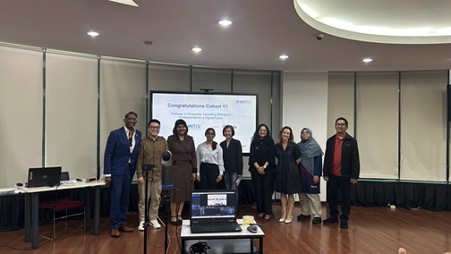
The Pathway to Prosperity Programme, powered by Google and implemented by the Division for Prosperity at the United Nations Institute for Training and Research (UNITAR), is a hybrid training programme designed to equip early and mid-career Selangor professionals with practical, industry-relevant skills in AI and data centre infrastructure. Cohort 1 brought together Selangor based participants for a combination of asynchronous learning, engaging weekly Saturday webinars and hands-on in-person workshops at SHRDC, bridging the gap between professional experience and the rapidly evolving demands of the AI and data centre industry.
ABOUT UNITAR
Established in 1965, the United Nations Institute for Training and Research (UNITAR) is the dedicated training arm of the United Nations. Its mission is to strengthen knowledge and skills through high-quality training, research and innovative learning solutions.
Through strategic partnerships and a global learning platform, UNITAR builds skills of individuals, and enhances capacities of institutions and organizations, particularly those in vulnerable contexts, to accelerate progress towards the 2030 Agenda for Sustainable Development and the Pact for the Future.