

- Danny McQueen participated in Cohort 1 of the Pathway to Prosperity Programme, implemented by the Division for Prosperity at the United Nations Institute for Training and Research (UNITAR) and supported by Google.
- A freelance consultant and former head of department at a Malaysian telecommunications company, Danny joined the programme with twenty years of project management experience behind him.
- The programme's online Moodle modules, live webinars featuring expert speakers and hands-on in-person workshops at SHRDC gave him the conceptual grounding, technical vocabulary, and practical tools to work and think differently.
- Since completing the programme, Danny has integrated AI tools directly into his freelance consultancy work, begun introducing them to friends running businesses, and passed the knowledge on at home.
UNITAR
May 2026, Geneva, Switzerland — When Danny McQueen joined Cohort 1 of the Pathway to Prosperity Programme, he was carrying twenty years of project management experience and a misconception most people share. "I always thought AI was actually ChatGPT. That's it. I thought you just ask questions and it answers back." Data centres, he assumed, were equally modest: "I thought it was just a small centre which keeps your data. I didn't know it was a huge kind of construction — with cooling systems and diverse equipment."
Danny began the programme with a curiosity for more, from his years leading infrastructure rollouts as head of department at a major Malaysian telecommunications company. Prior to his early retirement, he managed teams delivering large-scale tower construction nationwide, and had begun exploring AI integration in his work, including facial recognition technology developed with overseas partners. When the Pathway to Prosperity Programme was announced, it offered him the opportunity to close that gap. "When this programme started, it actually sent me on a curiosity to go and see how far this thing has gone from where I left."
I didn't want to use any of these tools — I thought it was all hype. But when I tried them, it was mind-blowing. I sent them to my daughter. She can now create a slide in half an hour instead of days. These are things which improve daily life." — Danny McQueen, Cohort 1, Pathway to Prosperity Programme
The Programme that Turned Curiosity Into Capability
UNITAR
The programme's design met Danny's curiosity with structure. The self-paced Moodle modules introduced him to what a data centre actually is, from its infrastructure demands to its energy considerations and daily operations. "The Moodle modules were actually one of the best parts," he said. "They taught me how to learn — from reading daily to getting to know what a data centre is all about."
The live Saturday webinars deepened that foundation by connecting it to practitioners embedded in Malaysia's professional landscape. Ragunath 'Pak Joe' Murthy's sessions on AI tools and automation moved Danny from understanding to action. "I loved the webinar with Pak Joe. That inspired me to go further. After listening, I went hands-on and tried the tools he showed us. It was mind-blowing." The shared professional context speakers who understood the local industry and its realities made the material feel urgent and applicable rather than abstract.
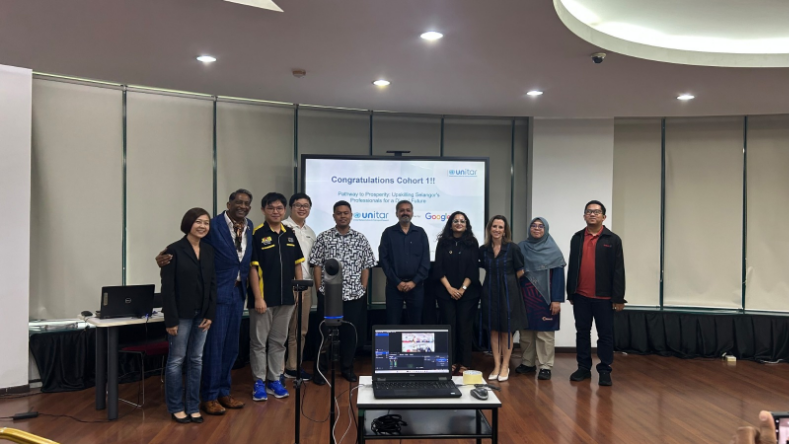
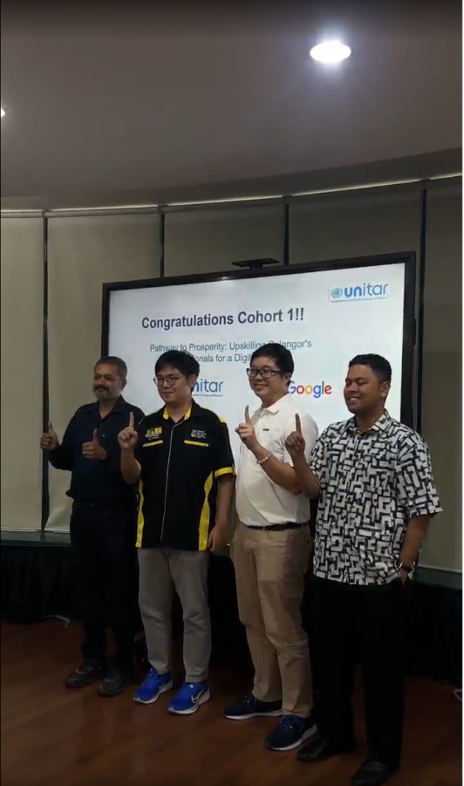
The in-person workshops at SHRDC were where application took its most concrete form. Working in a group of four, Danny and his teammates built a functioning prototype to monitor temperature in a data centre. "We actually came up with a prototype to measure temperature in an AI data centre." His team went on to win first place in Cohort 1 for their capstone presentation, and deservingly so.
From Weeks To Minutes: How Knowlegde Boosts Efficiency
Danny now uses tools introduced through the programme, such as WhisperFlow and NotebookLM, directly in his freelance consultancy work. The contrast with his previous approach is stark. "It's a must," he said of AI in project management. "What I've done for all these years is the traditional method — very old mindsets where we do our own slides, which takes about 2 to 3 weeks. Now you can do the same slide within a few minutes."
That efficiency, enabled by the programme, has moved well beyond his own practice. Danny’s "very old-school kind of” friends, who find AI intimidating, regularly come to him convinced that AI is too costly or too complicated to implement in their everyday business. He demonstrates otherwise. "I tell them, there are tools you can use to boost your productivity. They always come back and tell me it's very costly. I say no — just open the tool and somewhere it's free in the system." Tasks that once took two to three weeks are now completed in a fraction of the time.
The same knowledge has also travelled home. When Danny's daughter, studying business and AI at Sunway University, needed to research AI's origins for an academic paper, Danny had the precise answer. "I told her it was somewhere in the 1950s… Indirectly, I helped her with what she was preparing." The tools she first saw Danny use after the programme, AI-assisted slide creation, video generation, voice-to-text workflows, are now a part of her own academic toolkit. "She can create slides within half an hour compared to taking days or weeks."
The programme's reach extended further still. Alongside Pak Joe's technical sessions, the Saturday webinars brought in Mimi Nicklin, a Global Empathy Advocate based in Malaysia, whose work rests on the premise that in an age of AI and data centres, empathy and listening are not soft skills but performance-driving capabilities that directly impact engagement, output, and career advancement. Mimi’s practical, human-centred approach landed with particular force for Danny. "Mimi brought this word of empathy, a word of listening… which I really use in my life today, with my family members, my friends." Having spent two decades managing teams, Danny had practiced these principles instinctively. But the programme gave him the language, with which came intention.
Looking at the Future
Looking ahead, Danny's goals are framed not by what data infrastructure looks like today, but by what it will need to become. "It's not just build a centre for today. It's building a data centre for the future." His background in large-scale infrastructure project management gives him a distinctive lens. The questions he spent twenty years asking about telecommunications towers — how do you build for scale, for longevity, for resilience — are now being asked about data centres, and the programme gave him the language and the frameworks to engage with them.
To those in Selangor considering future cohorts, Danny is unambiguous about what the programme delivered: "It was well done, well blended — so nicely done within the span of three months. It's not just a reading kind of course. It was more interactive, where you actually brought the team together to get hands-on into the projects — until the last day, in-person."
Danny's story connects directly to SDG 4, 8 and 9, demonstrating how practical AI and data centre education can transform individual practice, extend into a professional network, and produce a second generation of learners within a single household.
About the Pathway to Prosperity Programme
The Pathway to Prosperity Programme, powered by Google and implemented by the Division for Prosperity at the United Nations Institute for Training and Research (UNITAR), is a hybrid training programme designed to equip early and mid-career Selangor professionals with practical, industry-relevant skills in AI and data centre infrastructure. Cohort 1 brought together Selangor based participants for a combination of asynchronous learning, engaging weekly Saturday webinars and hands-on in-person workshops at SHRDC, bridging the gap between professional experience and the rapidly evolving demands of the AI and data centre industry.
About UNITAR
Established in 1965, the United Nations Institute for Training and Research (UNITAR) is the dedicated training arm of the United Nations. Its mission is to strengthen knowledge and skills through high-quality training, research and innovative learning solutions.
Through strategic partnerships and a global learning platform, UNITAR builds skills of individuals, and enhances capacities of institutions and organizations, particularly those in vulnerable contexts, to accelerate progress towards the 2030 Agenda for Sustainable Development and the Pact for the Future.