

- Dr. Suthan Kaveri, physician and founder of ePink Health, postgraduate researcher at Universiti Malaya, and Digital Health Governance Intern at UNU-IIGH, participated in the Pathway to Prosperity Programme, powered by Google and implemented by the Division for Prosperity at UNITAR.
- A healthcare innovator, Dr. Suthan joined the programme fluent in clinical AI, but missing the data infrastructure foundations needed to scale digital health tools in the real world.
- Since completing the programme, he has supported how ePink Health scales its technology, how his team at Universiti Malaya evaluates research readiness, and how infrastructure readiness features in the governance drafts he works on at UNU-IIGH
- He has built these lessons into the clinical AI training he delivers across Bangladesh and the region, having trained more than 1,200 physicians to date — turning a personal knowledge gap into a multiplier effect.
UNITAR
July 2026, Geneva, Switzerland — Like most physicians, Dr. Suthan's journey began at his patients' bedside. Treating patients every day also meant running up agaisnt the friction of the healthcare system, rigid electronic medical records, resource constraints, and delivery pathways that buckled under pressure. "Traditional, brick-and-mortar healthcare models simply cannot scale to meet modern public health demands," he said, describing the realization that pushed him to found ePink Health, a digital health ecosystem built to bring virtual care, remote monitoring, and digital pharmacy services to low-resource settings.
But building the technology was only half the battle. As his startup, his postgraduate research, and his work with the UN grew more technically demanding, Dr. Suthan kept running into the same wall.
We were founders, researchers, and policy people, but very few of us actually understood what was happening inside a data centre.
He had a strong foundation in applying AI to clinical workflows and virtual clinic ecosystems, but no formal training in the backend physical architecture underneath.
I needed to bridge the gap between frontend clinical software and the underlying data centre infrastructure.
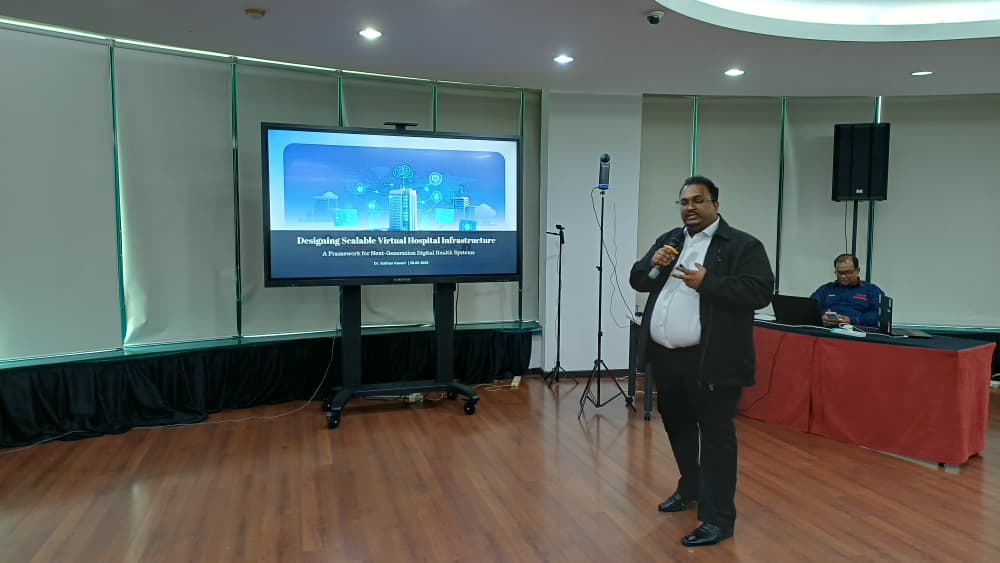
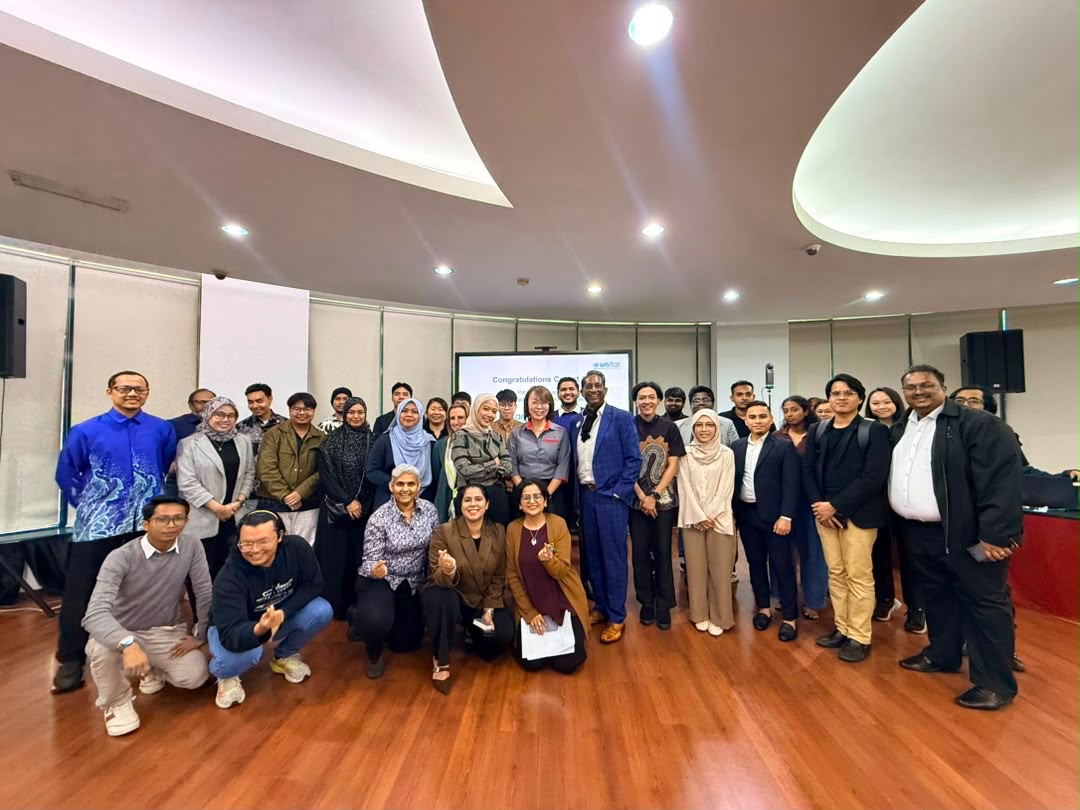
That gap is what brought him to Pathway to Prosperity, a programme designed for early and mid-career professionals in Selangor, delivered through online modules, weekly live webinars with regional and local experts, and hands-on workshops at SHRDC culminating in a final capstone presentation.
LEARNING TO SEE THE MACHINE BEHIND THE APP
UNITAR
For Dr. Suthan, the webinars were where the shift in mindset began. Hearing directly from data centre practitioners about server latency, uptime, and compute capacity was different from reading about them in the abstract. "You start to see AI as something physical, something with weight," he said. "Not just an app."
That shift deepened as the modules moved into the physical demands of data centres and the computational weight of scaling AI workloads.
Learning about localized server demands, processing pathways, and data architecture grounded these concepts, allowing me to look past the user interface and see the operational realities that dictate whether a digital health tool can successfully scale.
It reshaped how he understood failure itself, recognizing that clinical utility and user resistance are rarely the cause of digital health implementation failures. "They are frequently infrastructure bottlenecks. Without sustainable data infrastructure, true health equity cannot be achieved."
By the time he reached the SHRDC workshops and his capstone presentation, Dr. Suthan was no longer treating infrastructure as background knowledge. He was applying it directly to his own ecosystem at ePink Health, and it was there that the outline of a new checklist, one he would go on to use across three institutions, began to take shape.
FROM CAPSTONE TO CHECKLIST
That checklist — an Infrastructure-Aware Feasibility and Governance Checklist — is the clearest mark the programme has left on his daily work. It maps host server capabilities, data storage standards, bandwidth limitations, and compliance with data localization frameworks at the earliest stages of a project. The point is to stop the team building or recommending top-down software solutions destined to fail on inadequate bottom-up backend infrastructure.
It has changed how he operates across all three institutions: re-architecting how ePink Health's backend handles heavy clinical data during its migration from Cordova to Flutter, expanding Universiti Malaya's research evaluation criteria to include backend infrastructure capability, and embedding infrastructure readiness as a baseline prerequisite in UNU-IIGH's global governance drafts.
Applying it was not always straightforward. Dr. Suthan moves daily between clinicians, engineers, ethics boards, and policy analysts, each speaking their own dialect. His answer was to translate: server latency and uptime into patient safety, and compute capacity into research validity and national health sovereignty. That same translation now shapes the clinical AI training and keynotes he delivers to physicians across Bangladesh and the region, training more than 1,200 clinicians so far.
Had he not attended Pathway to Prosperity, Dr. Suthan believes his work would have continued on the same track, clinically strong but structurally exposed.
A BLUEPRINT BEYOND ONE ORGANISATION
The migration to Flutter at ePink Health moved faster with fewer backend scaling conflicts, and research protocol reviews at Universiti Malaya became more streamlined. Colleagues noticed too. Both his junior and senior colleagues now increasingly consult him on issues such as cloud architecture and the technical feasibility of new research projects.
For Dr. Suthan, the significance extends past his own institutions. Anchoring Malaysia's digital health innovations on efficient, secure infrastructure supports the country's broader digital economy ambitions, building citizen trust in digital public systems and creating high-value work at the intersection of health and technology.
His message to those weighing whether to expand programmes like this is direct:
Software and policy without a technical infrastructure foundation are built on sand. Expanding this opportunity ensures that the leaders driving our digital future possess the holistic, infrastructure-aware expertise required to build tech ecosystems that are truly secure, scalable, and equitable for everyone.
Dr. Suthan's story connects directly to SDGs 3, 9, and 17, demonstrating how equipping a healthcare innovator with infrastructure literacy strengthens health systems, builds resilient digital infrastructure, and creates the cross-sector partnerships needed to scale equitable digital health globally.
About the Pathway to Prosperity Programme
The Pathway to Prosperity Programme, powered by Google and implemented by the Division for Prosperity at the United Nations Institute for Training and Research (UNITAR), is a hybrid training programme designed to equip early and mid-career Selangor professionals with practical, industry-relevant skills in AI and data centre infrastructure. Cohort 1 brought together Selangor based participants for a combination of asynchronous learning, engaging weekly Saturday webinars and hands-on in-person workshops at SHRDC, bridging the gap between professional experience and the rapidly evolving demands of the AI and data centre industry.