

- Tan Yu Xian participated in Cohort 1 of the Pathway to Prosperity Programme, powered by Google and implemented by the Division for Prosperity at the United Nations Institute for Training and Research (UNITAR).
- The hybrid programme is designed for early and mid-career professionals seeking to upskill in AI and data centre infrastructure, combining e-learning with online Saturday webinars and in-person workshops at SHRDC, Malaysia.
- An Electrical and Electronic Engineering student from Kolej Pendeta Zaba, Universiti Kebangsaan Malaysia (UKM), Tan was one of the youngest participants in his cohort. He joined to explore the intersection of AI and data centre infrastructure, a field adjacent to, but meaningfully beyond, the boundaries of his formal degree.
- He was motivated to apply after discovering the programme on LinkedIn, drawn by its focus on AI and the flexibility of its hybrid format.
- After completing the programme, he secured a part-time, hybrid internship at reAInmaker AI (a company specialising in AI and robotics) – a tangible outcome of the technical skills and industry network the programme helped him build.
UNITAR
May 2026, Geneva, Switzerland — When Tan Yu Xian first joined Cohort 1 of the Pathway to Prosperity Programme, he found himself in a room of working professionals: engineers, managers and specialists, some with twenty or thirty years of industry experience behind them. The programme has been designed for exactly this audience: early and mid-career professionals upskilling in AI and data centre infrastructure, two of the fastest-moving fields in the global economy.
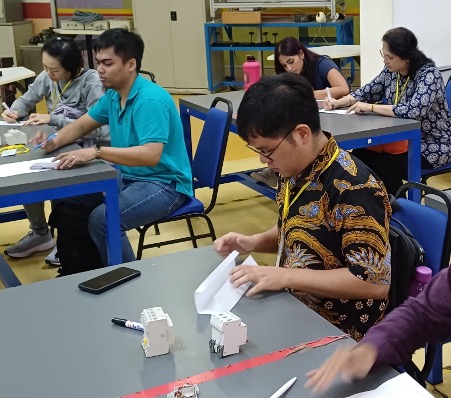
Tan, an Electrical and Electronic Engineering student from Kolej Pendeta Zaba, UKM, was the exception. He had spotted the programme through a LinkedIn post; the word ‘AI’ had caught his attention, and the hybrid format of Saturday webinars and three day in-person workshops at SHRDC on weekends meant he could commit to it without disrupting his studies. He signed up, curious about where it might lead.
Prior to joining, Tan had some exposure to AI through training at Switch RDC2. Data centre infrastructure, however, was entirely new territory. As he reflects, the programme turned out to be around 50% aligned with his engineering degree — and entirely relevant to where he wants to go professionally.
This course helped me to understand more about data centres and also helped me to explore new careers and new industries related to electrical and electronics engineering. — Tan Yu Xian
DISCOVER THE VALUE OF PEOPLE
UNITAR
It is perhaps unexpected that a programme centred on AI and data centre infrastructure would leave its deepest mark not through technical content alone, but through the people Tan encountered along the way.
The cohort drew together professionals across industries and seniority levels. For Tan, the conversations were a window into how experienced practitioners frame problems, navigate careers and translate technical knowledge into business impact.
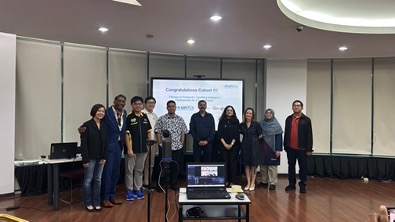
The capstone presentation day was a particular turning point. Watching his fellow participants present their projects, each grounded in their own professional background, shifted how Tan thought about knowledge itself.
During the presentation day, I realised that all the participants were amazing. They presented their capstone projects based on their professional backgrounds. I could learn from them: how they present, and how they relate their profession to the capstone project.
That insight reshaped how Tan understood his own learning. Technical content, he came to see, was no doubt critical but still a part of the picture — the real differentiator was learning to think like a practitioner, to connect knowledge to context, and to draw on the wisdom of others who had already walked the path.
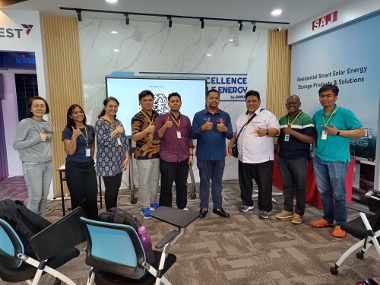
The professional connections Tan built during the programme's in-person sessions would soon open a door he had not expected to reach for another two years.
BUILD TOOLS THAT WORK FOR YOU
UNITAR
The programme's physical workshops at SHRDC introduced Tan to n8n, an open-source AI automation platform. Where another participant might have filed this away as a course exercise, Tan took it home and kept building.
His first independent project was an AI-powered Resume Generator — an automation workflow that takes a job title and its responsibilities as input and produces a tailored CV as output. Beyond that, he applied the same automation logic to repetitive daily tasks such as email management, reclaiming time for higher value work.
The process was not always smooth. Workflows ran into errors; debugging took patience; balancing it all against a full academic load demanded careful time management. But the discipline of building, breaking and fixing left him with something more valuable than any single tool.
It saves a lot of time for me. And the most important thing is that it taught me how to think — how to think in a different way to find problems and to solve them.
He has also shared what he learned. Friends who expressed curiosity about his capstone project were met with a demonstration and, for those who wanted to go further, informal instruction in how to use the tools themselves.
SECURE AN OPPORTUNITY AHEAD OF TIME
The most tangible outcome of Tan's participation in the programme is one that reflects both the skills he developed and the network he built: a confirmed part-time, hybrid internship at reAInmaker AI, an AI and robotics company.
By the time the opportunity surfaced, Tan had already moved through the programme's full arc — Saturday webinars covering AI fundamentals and data centre infrastructure, hands-on in-person workshops at SHRDC where he was introduced to tools such as the n8n AI automation platform, and a capstone project that required him to apply what he had learned to a real-world problem. That progression gave him something concrete to point to when the moment came.
It was during the programme's first in-person sessions, through a presentation delivered by UNITAR programme team that Tan first learned about the opportunity. He submitted his CV to UNITAR programme team who connected him with reAInmaker AI. The company's HR manager followed up directly, and within 6 weeks since completing the programme, Tan is working part-time and hybrid with reAInmaker AI, balancing the role alongside his ongoing studies.
What makes this outcome particularly significant is the position Tan was in when he applied. Internships in AI and robotics typically expect candidates with substantial technical grounding and prior project experience. The combination of structured upskilling, a tangible capstone deliverable and direct industry exposure through the programme allowed Tan to present himself as someone ready to contribute from day one.
The largest impact for me after this programme is the internship offer from reAInmaker. The webinars, the workshops, the capstone — all of it gave me something concrete to show, and the connections to put it in front of the right people. That's the biggest impact for me.
LOOKING AT THE FUTURE
At reAInmaker AI, Tan will be working with microcontroller technologies such as the ESP32 — work that draws on his engineering foundation while deepening his expertise in applied AI. He is already thinking about how to integrate what he learned through the Pathway to Prosperity Programme into the projects ahead.
His advice to those considering future cohorts reflects the mindset that has guided his own journey: "Be curious. Always talk to other people, no matter their age. And always explore yourself — don't just limit your knowledge to theory, but also explore during your free time."
Tan's story connects directly to SDG 4, 8 and 9, showcasing how access to quality AI and data centre education beyond his formal degree enabled him to secure a new role at a local organization and contribute to his wider community through his continued work.
About the Pathway to Prosperity Programme
The Pathway to Prosperity Programme, powered by Google and implemented by the Division for Prosperity at the United Nations Institute for Training and Research (UNITAR), is a hybrid training programme designed to equip early and mid-career Selangor professionals with practical, industry-relevant skills in AI and data centre infrastructure. Cohort 1 brought together Selangor based participants for a combination of asynchronous learning, engaging weekly Saturday webinars and hands-on in-person workshops at SHRDC, bridging the gap between professional experience and the rapidly evolving demands of the AI and data centre industry.
About UNITAR
Established in 1965, the United Nations Institute for Training and Research (UNITAR) is the dedicated training arm of the United Nations. Its mission is to strengthen knowledge and skills through high-quality training, research and innovative learning solutions.
Through strategic partnerships and a global learning platform, UNITAR builds skills of individuals, and enhances capacities of institutions and organizations, particularly those in vulnerable contexts, to accelerate progress towards the 2030 Agenda for Sustainable Development and the Pact for the Future.