

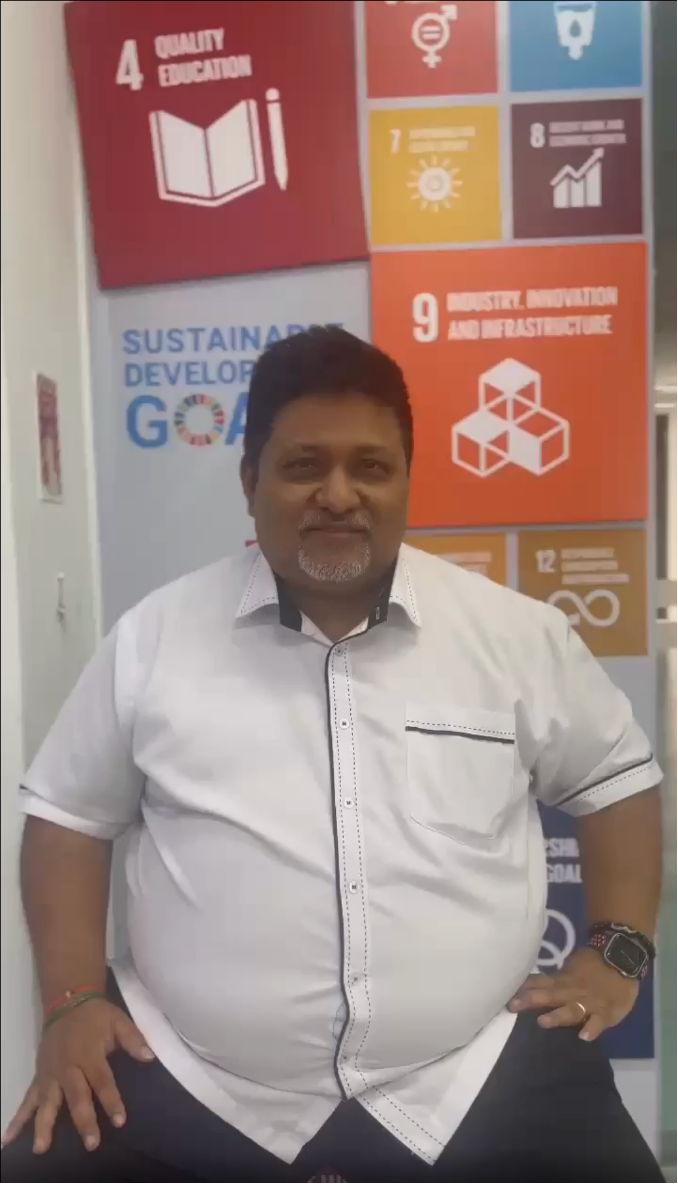
- Murugeson Ayasamy, known as Captain Muru, participated in Cohort 1 of the Pathway to Prosperity Programme, powered by Google and implemented by the Division for Prosperity at the United Nations Institute for Training and Research (UNITAR).
- A community leader representing the Rotary Club of Nilay Central and District 3300 Malaysia, Captain Muru joined the programme to equip himself and his NGO network with practical AI knowledge, so that the communities he serves could stay connected to a rapidly changing world.
- Since completing the programme, he has fundamentally transformed how his Rotary-affiliated campaigns reach communities, with his chronic kidney disease prevention campaigns serving as a flagship example: moving from printed pamphlets to AI-powered social media content, achieving dramatically wider reach and improved health screening turnout.
- Beyond his own practice, Captain Muru has become a community multiplier by sharing his knowledge with fellow Rotarians, encouraging participation in future cohorts, and championing AI access for young people and those living with disabilities.
UNITAR
May 2026, Geneva, Switzerland — When Captain Muru joined Cohort 1 of the Pathway to Prosperity Programme, he was not looking for a career pivot. He had already built one through decades in the private sector, a PhD in Digital Economy, and a steady shift towards community leadership through the Rotary Club of Nilay Central and District 3300 Malaysia.
We are following the evolution, and we are able to connect with the community, especially the younger generation, and relay the older philosophies to them using the younger generation’s technology. That’s the major bridge that I see.”
— Captain Muru, Cohort 1, Pathway to Prosperity Programme, Rotary Club of Nilay Central and District 3300 Malaysia
Designed for the local community in Selangor, the programme offered precisely what Captain Muru was searching for– a structured route into the practical realities of AI and data centre technology. What drew him to the programme was a recognition that the tools his NGO campaigns relied heavily on were falling behind the pace of the communities they were meant to serve. "We were trying to evolve around the future where AI and technological advancement is going to happen," he reflected. "We wanted our NGOs to stay connected and be relevant to the communities we are serving."
FROM BABY STEPS TO BUILDING BRIDGES
UNITAR
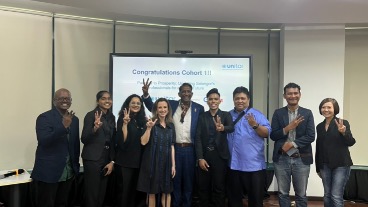
Joining a cohort of early and mid-career professionals, Captain Muru arrived as one of the more experienced voices in the room. And yet, he found himself genuinely humbled by what he encountered. "Though I was exposed to that area of knowledge, still I wanted to enrich myself further. And sure enough, I found myself learning a lot more from the young generation. We find ourselves still in baby steps compared to them."
Two things from the programme struck him with particular force. The first was that moving towards AI and smarter data infrastructure was not just an economic efficiency story, it was an environmental one. The programme connected the dots between reducing energy, materials, and human labour in data-intensive operations and the broader question of climate impact. "Going this direction is not only saving cost, but it's also saving the planet," he said. "That's the most important thing."
The second was a matter of scale. What landed was not a concept but a concrete reality that AI systems were already processing data at volumes that make traditional paper-based documentation structurally impossible to maintain. The infrastructure he was learning was the engine behind the kind of reach he wanted for his own campaigns. On the programme's design, he was straightforward: "very relevant, not excessive… just perfectly suited for the crowd, for us."
That understanding moved quickly from insight to practice. Through the programme, Captain Muru became familiar with tools like n8n and Wazuh and found that knowing them opened unexpected doors. "I can talk to somebody who's 20 years old, 21 years old, and talk to them about n8n and Wazuh — they look very surprised." For a community leader trying to build bridges across generations, that shared vocabulary proved to be its own kind of asset.
WHEN AWARENESS SAVES LIVES: THE CKD CAMPAIGN
The most vivid illustration of what changed after the programme is the campaign Captain Muru and his Rotary network run on chronic kidney disease (CKD) prevention.
Before the programme, the approach was one familiar to anyone working in community health: printed pamphlets, leaflets, face-to-face talks, and workshops. These efforts reached people, but slowly. Convincing communities to attend health screenings and take prevention seriously remained a stubborn challenge. What the programme changed was Captain Muru's ability to execute the campaigns at an entirely different scale. Equipped with AI tools and the confidence to deploy them. Using AI-assisted platforms, the CKD campaign shifted onto TikTok and social media. AI-generated visual and audio content made the medical reality of the disease tangible and immediate in ways a leaflet could never achieve. "Today, with AI, we are reaching through TikTok, we are reaching through other social medias, and the awareness is reaching a thousand times faster than it was conventionally," Captain Muru said. "We are creating images which are more realistic, and people realise the seriousness of chronic kidney disease."
The results were measurable. Community response to health screenings improved markedly. Moreover, prevention, historically the hardest goal to advance, began to gain real traction. The impact is clear: without the confidence, tools, and network built through the programme, those campaigns would still be running on pamphlets.
LEARNINGS THAT RIPPLE OUTWARDS
The effects have moved well beyond Captain Muru's own practice. He and his Cohort 1 classmates have stayed in touch since completing the programme, continuing to share what they learned, track the field together, and press into what their foundations might support next. The ripple into his wider Rotary network has also been tangible, where fellow Rotarians are now being actively encouraged to join future cohorts.
Captain Muru has also turned his attention to a community that rarely features in conversations about digital opportunity people living with disabilities. For him, AI's potential here is straightforward and powerful. The ability to build a livelihood through AI-enabled work, from anywhere, without physical constraints, has become a message he now actively carries into his community leadership.
Looking ahead, his next vision is AI-enabled virtual education for underprivileged communities — the possibility that a student in Malaysia could access the same quality of teaching as one anywhere else in the world, without physical presence ever being a barrier. "Education at the larger scale," is how he puts it. "Where the underprivileged community might be staying in Malaysia, but get the same equal education that is being offered in UK or London."
Captain Muru's story connects directly to SDGs 3, 4, 8 and 10, demonstrating how AI and technological upskilling for a community leader can improve health outcomes, expand access to education, and champion inclusion for the most vulnerable in society.
ABOUT THE PATHWAY TO PROSPERITY PROGRAMME
The Pathway to Prosperity Programme, powered by Google and implemented by the Division for Prosperity at the United Nations Institute for Training and Research (UNITAR), is a hybrid training programme designed to equip early and mid-career Selangor professionals with practical, industry-relevant skills in AI and data centre infrastructure. Cohort 1 brought together Selangor based participants for a combination of asynchronous learning, engaging weekly Saturday webinars and hands-on in-person workshops at SHRDC, bridging the gap between professional experience and the rapidly evolving demands of the AI and data centre industry.
ABOUT UNITAR
Established in 1965, the United Nations Institute for Training and Research (UNITAR) is the dedicated training arm of the United Nations. Its mission is to strengthen knowledge and skills through high-quality training, research and innovative learning solutions.
Through strategic partnerships and a global learning platform, UNITAR builds skills of individuals, and enhances capacities of institutions and organizations, particularly those in vulnerable contexts, to accelerate progress towards the 2030 Agenda for Sustainable Development and the Pact for the Future.