

13–14 May 2026, at the UN House Brussels in Belgium
UNITAR
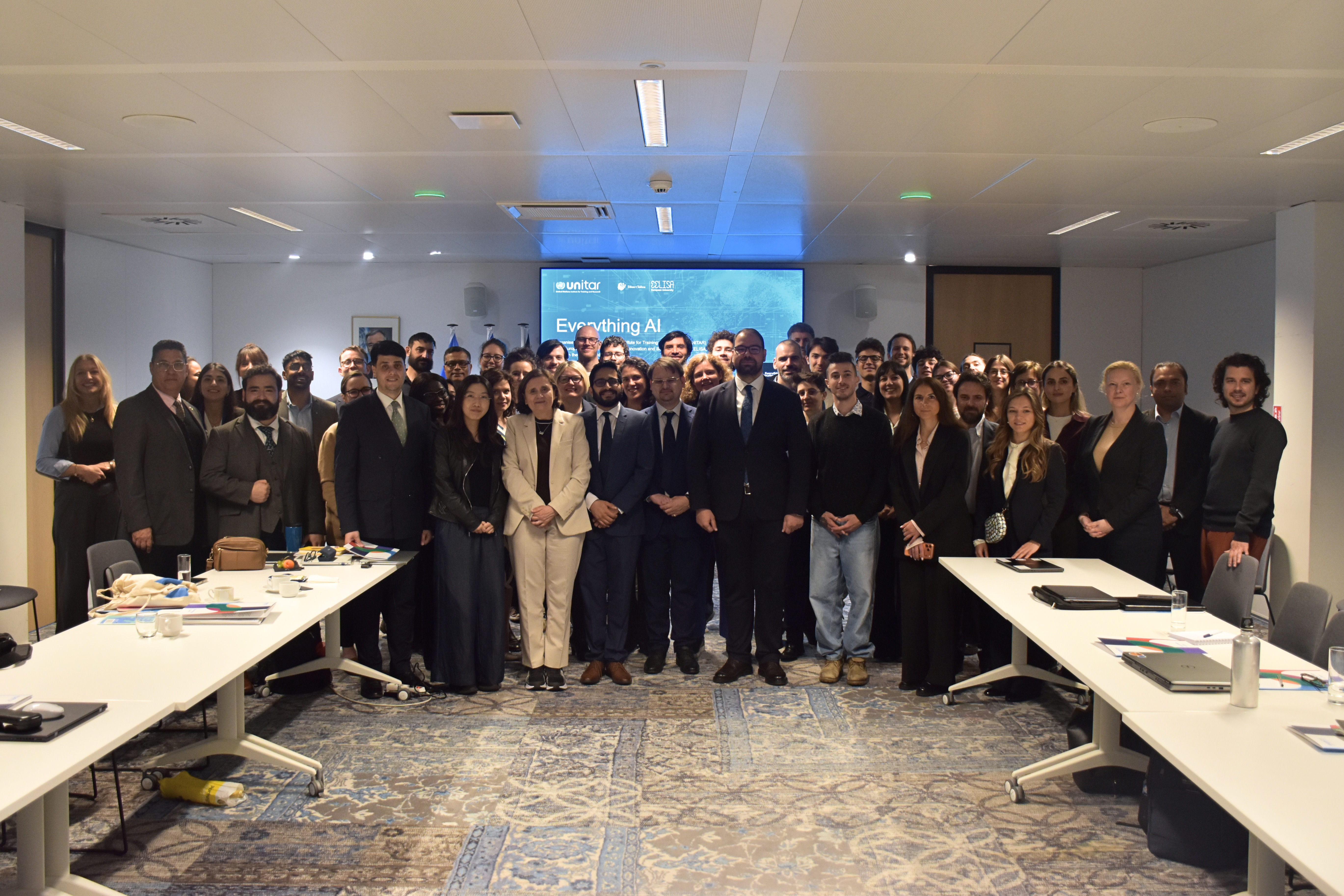
19 February 2026, Bonn, Germany - The Everything AI conference, held in Brussels and online on 13–14 May 2026, brought together an international and multidisciplinary community of policymakers, researchers, engineers, legal experts, and practitioners to examine artificial intelligence as a system wide force shaping governance, institutions, and society.
The event was organised jointly by the United Nations Institute for Training and Research (UNITAR) and the Ethos+Tekhné community of the European Engineering Learning Innovation and Science Alliance (EELISA), fostering dialogue at the intersection of technology, society, and governance.
Over the course of two days, the conference provided a space for open and substantive dialogue on the operational realities of AI governance, moving beyond conceptual debates to focus on implementation, accountability, and institutional practice. The discussions addressed key challenges including regulatory frameworks, cybersecurity and adversarial risk, judicial systems, democratic resilience, and the broader societal implications of emerging technologies.
Participants took part in exchanges that connected technical, legal, and policy perspectives, reflecting the need for coordinated and cross sector responses to the complexity of AI deployment and oversight. At the event it was asserted the importance of translating regulatory ambition into workable solutions, informed by real world constraints and institutional contexts.
Everything AI reaffirmed the value of collaboration, shared understanding, and continued dialogue in advancing responsible and forward looking approaches to artificial intelligence. UNITAR and the Ethos+Tekhne community extend their sincere appreciation to all participants and contributors for their role in supporting collective efforts towards effective, accountable, and inclusive AI governance.
File
Concept Note & Agenda1.83 MB
Why Participate?
Across two days, participants will engage Global South perspectives, examine how agentic AI behaves outside controlled environments through the Moltbook case discussion, and assess what engineering can, and cannot, guarantee through robustness and assurance frameworks. Sessions will explore how ethical commitments translate into standards and operational controls, as well as AI’s implications for judicial systems, democratic resilience, health and privacy, and institutional accountability. Additional discussions will address digital twins for policymaking (DestinE), cybersecurity, red-teaming and adversarial risk, and the intersection of AI with post-growth and sustainability agendas.
Designed to prioritize exchange over formal statements, the programme combines keynote interventions, expert panels, and thematic workshops to foster practical, outcome-oriented discussions. Participants can expect structured question-and-answer sessions and a focus on clear, implementable takeaways that bridge policy ambition with operational feasibility.
Bringing together approximately one hundred international policymakers, researchers, and practitioners, including representatives from international organizations, academia, public institutions, civil society, and technical communities.
We welcome:
- Policymakers, regulators, and public authorities at national, regional, and international levels;
- Representatives of United Nations agencies and international organizations;
- Academic researchers and scientific experts;
- Civil society leaders, ethics practitioners, and human rights-focused stakeholders;
- Technology governance specialists, standards and assurance professionals, and digital policy advisors;
- Institutional leaders and senior decision-makers responsible for AI strategy, risk management, and accountability.
Thematic Areas
Through high-level panels, expert-led thematic sessions, and case-focused discussions intersecting different sectors, participants will engage with key themes including:
1) Policy, Oversight, and Institutional Accountability
EU AI Act implementation: oversight, standards, and operationalisation
Accountability frameworks and institutional controls
Privacy, and AI in sensitive domains
Digital twins and AI-driven policymaking (DestinE)
2) Security, Risk, and AI in High-Stakes Environments
Cybersecurity, red-teaming, and adversarial risk
Agentic AI in uncontrolled environments (Moltbook case discussion)
Courts and judicial risk in the age of generative AI
Democracy, elections, misinformation, and public trust
3) Society, Power, and Sustainable Futures
Knowledge, expertise, and epistemic authority
AI, inequality, and structural power
AI, post-growth, and sustainability
Submit Your Application (Closed)
This is an application-based event; interested participants are encouraged to apply early before the deadlines. Applications will be reviewed by our team on a rolling basis. Accepted applicants will receive detailed registration instructions via email.
Please note that payment is required to finalize registration to secure a place in the event. Proof of payment must be sent to elearning.ptp@unitar.org. Registration will be confirmed upon verification of payment.
In-Person Attendance
- In-person Application and Registration Deadline: 11 April 2026.
- In-person Fee: 360 USD - Payment Deadline: 18 April 2026.
Online Attendance
- Online Application and Registration Deadline: Extended until the 8th of May 2026.
- Online Fee: 300 USD - Extended until the 8th of May 2026
Contacts
Online Learning and Education (UNITAR)
E-mail: elearning.ptp@unitar.org
Cynthia El-Khoury
Instructional Designer, Online Learning and Education (UNITAR)
E-mail: cynthia.elkhoury@unitar.org
Partners
Organized by the United Nations Institute for Training and Research (UNITAR) and EELISA Ethos+Tekhne.