

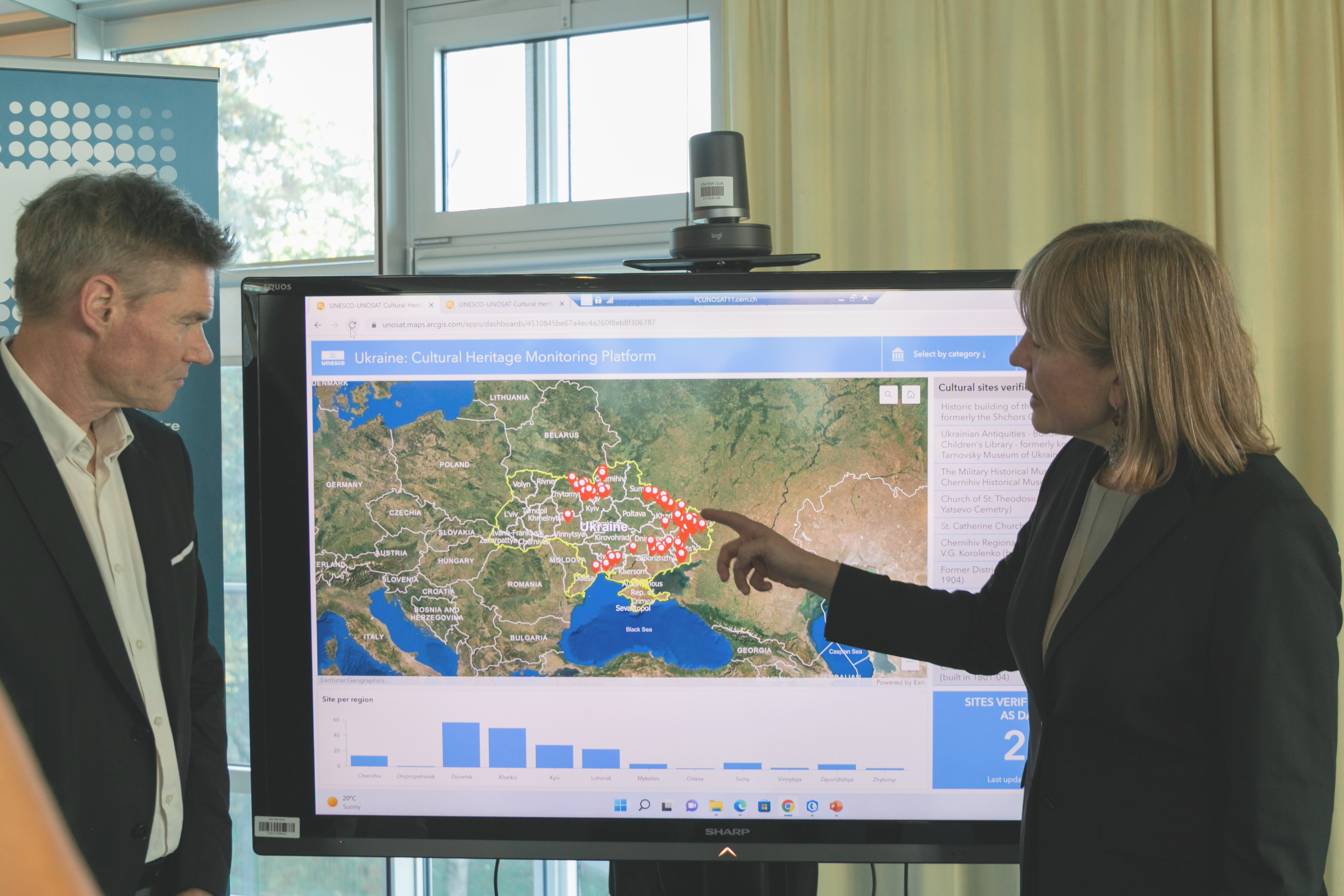
Figure 1. Einar Bjørgo, former Director (2018-2024) of the United Nations Satellite Centre (left), and Krista Pikkat, Director of the UNESCO Culture and Emergencies Entity (right), at a joint press conference in Geneva, Switzerland, 26 October 2022
For more than 10 years, the United Nations Educational, Scientific and Cultural Organization (UNESCO) and the United Nations Satellite Centre have worked together on satellite-based monitoring of cultural and natural heritage affected by armed conflict and disasters resulting from natural or human-made hazards. This partnership was formalized through a Memorandum of Understanding signed in 2015 and subsequently strengthened through a series of joint agreements, funded by UN Member States, to monitor and safeguard cultural and natural heritage around the world. What began as ad-hoc assessments for Iraq and Syria has evolved into systematic, joint operations with rapid, global response capabilities.
Systematic Joint Assessments
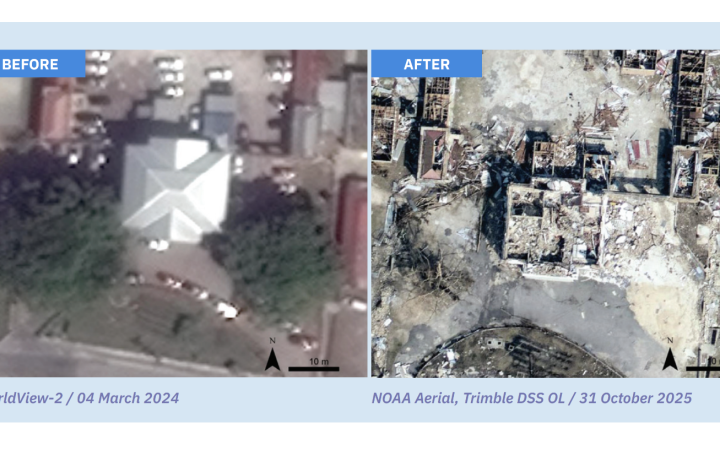
UNESCO and the United Nations Satellite Centre are natural partners that combine different sources of information and analysis to provide a comprehensive verification of the state of cultural and natural heritage around the world.
UNESCO, as the only United Nations agency with a specific mandate in culture, has worked to safeguard and protect cultural and natural heritage over the past 80 years. It has offices in 54 countries around the world, including those in critical countries such as Ukraine.
The United Nations Satellite Centre is the central operational geospatial service mandated to assist UN funds, programmes, specialized agencies, and Member States with satellite imagery-based analysis, training, and capacity development in geographic information technology.
The combination of ground-based information and satellite imagery joint analysis by UNESCO and the United Nations Satellite Centre provides complementary and mutually reinforcing evidence. This combined approach is particularly valuable in humanitarian emergencies for assessing damage and risks and for informing response and recovery efforts.
Ground information can document the condition of interior spaces, façades, and collections, as well as looting from museums and archaeological sites. Satellite imagery complements this by providing information from both accessible and inaccessible areas, including structural damage to buildings, looting, and earth movements at archaeological sites, and by detecting changes in vegetation health, as well as land cover and land-use patterns affecting natural heritage.
Working together, the United Nations Satellite Centre and UNESCO verify reports of damage immediately following a disaster or the outbreak of hostilities, providing a preliminary assessment ahead of ground missions and supporting Member States in monitoring evolving emergency situations.
A Strong Partnership
At the core of this strong partnership is close and regular communication between all levels of management and their respective technical teams, ensuring an integrated workflow and robust analysis that both organizations can act upon.
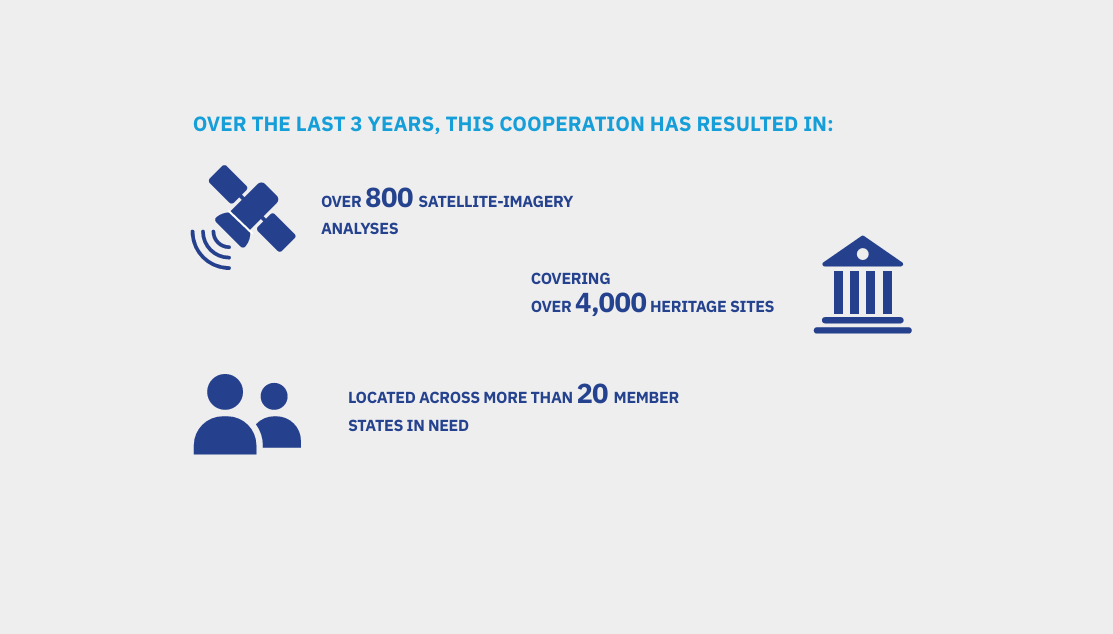
- Over the last 3 years, this cooperation has resulted in:
- over 800 satellite-imagery analyses, covering
- over 4,000 heritage sites, located across
- More than 20 member states are in need.
UNESCO and the United Nations Satellite Centre also work to ensure that cultural heritage is integrated into broader humanitarian responses and recovery planning frameworks, including the Rapid Damage and Needs Assessment (RDNA) report for Gaza. This includes ensuring that cultural heritage is integrated alongside other sectors in the development of baseline datasets following major events. As the UN system’s operational geospatial service, the United Nations Satellite Centre plays a key role in this process.
In the context of humanitarian emergencies such as tropical cyclones, earthquakes, and fires, UNESCO is able to trigger the United Nations Satellite Centre’s Emergency Mapping Service for cultural heritage, ensuring that cultural heritage is included alongside other sectors and critical infrastructure within wider humanitarian responses. As a signatory of the International Charter Space & Major Disasters, the United Nations Satellite Centre can also activate the charter on behalf of UNESCO (and other UN agencies), further helping to integrate cultural heritage into humanitarian responses to disasters. When the Charter is activated, the United Nations Satellite Centre and other signatories coordinate using the Global Disaster Alert and Coordination System (GDACS-SMCS) and its Satellite Mapping Coordination System to avoid duplication and maximize coverage as rapidly as possible.
Working Together to Strengthen Others
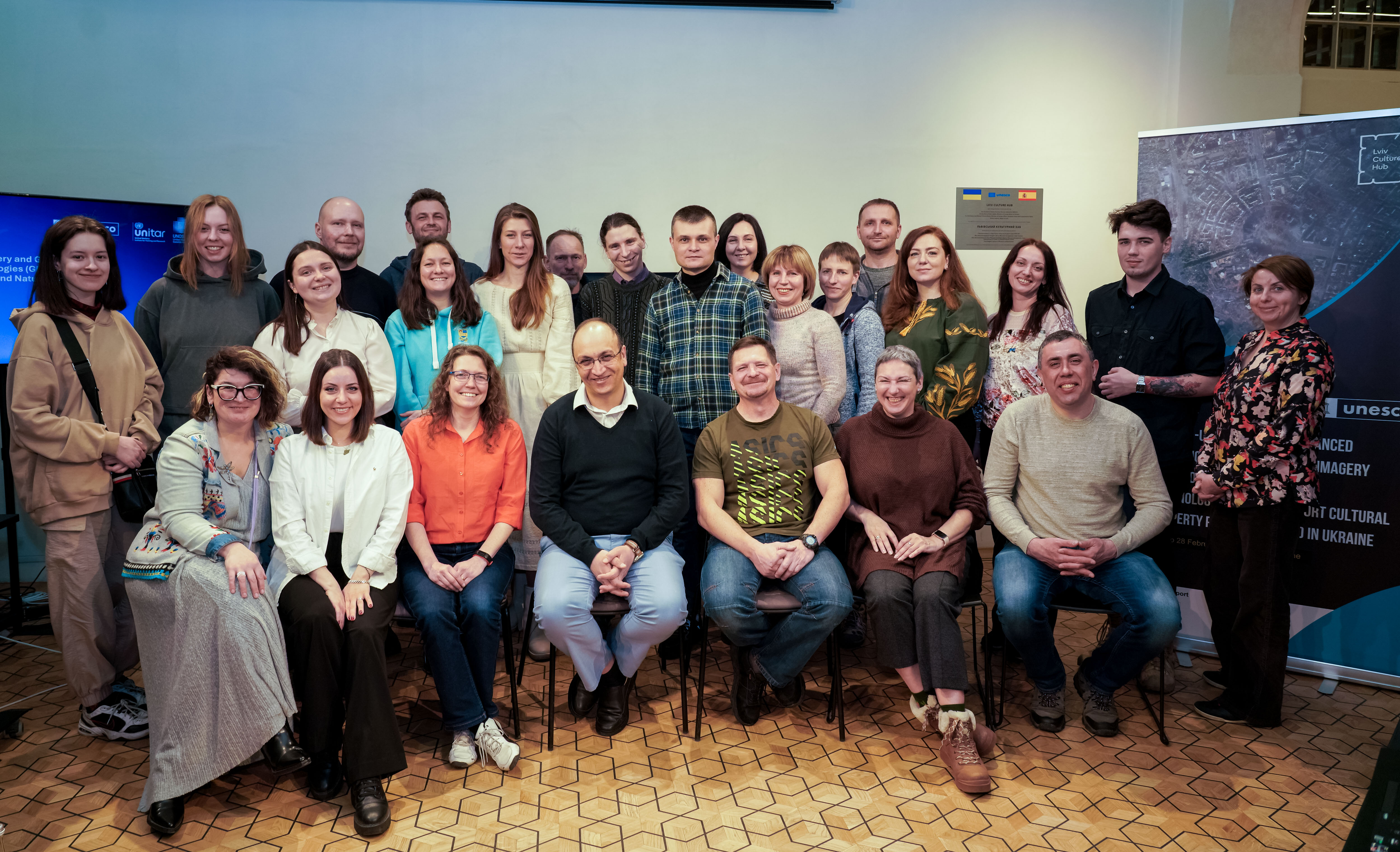
Figure 3. UNESCO and the United Nations Satellite Centre pose with participants from the February 2025 capacity building training event inside the Lviv Culture Hub in Lviv, Ukraine, (C) UNESCO/Vitaliy Hrabar
With support from UNESCO, the United Nations Satellite Centre has developed and delivered a flexible programme of multi-day, practical capacity building trainings for heritage professionals in Geographic Information Technology, including satellite imagery analysis. A modular structure makes it possible to adapt the training to different contexts.
All components of the training programme provide capacity building in free and open-source solutions, ensuring participants leave with sustainable skills.
All modules are accompanied by booklets that contain the key information from lessons and step-by-step instructions of all practical exercises conducted during the training. When physical booklets are issued, participants are provided with two copies: one copy to use during the training and support their own learning, and a second copy to help them share their knowledge with colleagues in their respective institutions.
By adopting a training-of-trainers approach, UNESCO and the United Nations Satellite Centre maximize the reach and impact of capacity building events.
The first training took place in Lviv, Ukraine, in 2023. Over four days, participants learned about satellite imagery, geospatial data, and where to source both; how to digitize and create their own geospatial data, conduct analyses, and publish maps using both Google Earth Pro and QGIS; how to read and write JavaScript and view and download satellite imagery in Google Earth Engine. This four-day training was repeated, by demand, in January 2025 in Lviv (Ukraine).
An additional four-day follow-on training was offered in February 2025, in Lviv (Ukraine), to the professionals who participated in the November 2023 and January 2025 training events. This follow-on training built upon participants’ knowledge, expanding into topics where they expressed an interest in learning more.
In 2025, the United Nations Satellite Centre -UNESCO training in Ukraine was recognized by Satcult, a European Commission initiative funded by the EU, as one of 12 (now 13) examples of good practice.
Now, UNESCO and the United Nations Satellite Centre are working together to find logistical solutions that will allow this practical capacity-building training programme to be delivered in a hybrid or even remote format without losing quality.
Looking forward
Climate change is increasing both the frequency and intensity of natural hazards like tropical storms, droughts, and floods that can cause humanitarian emergencies.
At the same time, increasing numbers of conflicts are actively damaging cultural and natural heritage sites, putting heritage in all its forms (tangible, intangible, immovable, and moveable) at risk in Member States around the world.
In response, UNESCO and the United Nations Satellite Centre are continuing to expand their joint capacity by more systematic monitoring in conflict zones and disaster-affected areas, building the skills of heritage professionals, and ensuring cultural and natural heritage remains embedded within international humanitarian response frameworks.
File